Why Use AI for Video: Transforming Creative Production
Why use AI for video? Discover practical benefits, types, and key features of AI-powered video creation for creative professionals and filmmakers worldwide.
Why Use AI for Video: Transforming Creative Production

Every creative professional knows the struggle of bringing ambitious video ideas to life while facing technical hurdles and tight deadlines. AI video creation promises a fresh approach, offering tools that transform manual production tasks into accessible, efficient workflows. With sophisticated algorithms and diverse generative models, these technologies help creators push boundaries and redefine visual storytelling. AI video creation empowers professionals to focus on creative expression without compromising quality or speed.
Table of Contents
- AI Video Creation Defined and Debunked
- Major Types and Capabilities in 2026
- How AI Streamlines Video Production
- Real-World Examples and Applications
- Critical Risks, Costs, and Limitations
- Comparing AI Video with Traditional Methods
Key Takeaways
| Point | Details |
|---|---|
| AI Video Creation | AI empowers creators by streamlining video production processes, making high-quality content more accessible. |
| Emerging Technologies | Future advancements will enhance video generation through personalized and contextually aware AI solutions. |
| Collaborative Nature | AI is a tool to augment human creativity, not replace it, emphasizing the importance of human oversight. |
| Cost and Efficiency | AI significantly reduces production costs and time, allowing creators to focus on storytelling rather than technical details. |
AI Video Creation Defined and Debunked
Artificial intelligence has transformed video production from a complex, technical process into an accessible creative tool. Unlike traditional methods requiring extensive technical skills, AI video creation enables professionals and creators to generate high-quality visual content through intelligent algorithms and sophisticated machine learning techniques.
The field of AI video generation encompasses several core technological approaches, primarily centered around advanced computational methods. Emerging research in computer vision reveals a complex ecosystem of generative modeling strategies that synthesize video content with unprecedented precision. These technologies integrate multiple sophisticated components:
- Computer vision algorithms that interpret visual data
- Generative adversarial networks (GANs) for content creation
- Machine learning models trained on extensive video datasets
- Sequence processing techniques for coherent video generation
- Advanced rendering engines that simulate realistic visual environments
Contrary to popular misconceptions, AI video creation is not about replacing human creativity but augmenting and streamlining production workflows. Academic research on digital content generation highlights that AI serves as a collaborative tool, helping creators transform raw concepts into polished visual narratives more efficiently than ever before.
While the technology shows immense promise, ethical considerations remain paramount. Professionals must navigate potential challenges like data privacy, algorithmic transparency, and responsible content generation. The technology is evolving rapidly, with ongoing research addressing deepfake detection, bias mitigation, and maintaining creative integrity.
Pro tip: Always review and refine AI-generated video content to ensure it authentically represents your creative vision and maintains high-quality standards.
Major Types and Capabilities in 2026
The landscape of AI video generation is rapidly evolving, with multiple sophisticated models emerging to revolutionize creative production. Generative AI technologies are poised to transform how visual content is conceived, produced, and distributed across multiple platforms and contexts.
In 2026, video creation AI will encompass several critical types of technological approaches:
- Text-to-Video Generative Models: Converting written descriptions into dynamic visual narratives
- Adaptive Streaming Technologies: Personalizing video experiences in real-time
- Multi-Modal Content Synthesis: Combining text, image, and video generation capabilities
- Context-Aware Video Analysis: Understanding and interpreting complex visual sequences
- Large Language Model (LLM) Enhanced Video Generation: Integrating advanced linguistic understanding into visual content creation
AI-generated multimedia content will demonstrate unprecedented capabilities in 2026, particularly in areas of content personalization and real-time generation. These technologies will enable creators to produce highly sophisticated videos with minimal technical intervention, bridging the gap between conceptualization and execution.
The most significant advancement will be the ability to generate contextually rich, hyper-personalized video content that adapts to specific audience requirements. This means AI systems will not just create videos but will understand nuanced creative intent, cultural contexts, and viewer preferences with remarkable precision.
Pro tip: Invest time in understanding AI video generation tools and experiment with different models to discover which best matches your specific creative workflow.
Here's a quick reference to major AI video creation technologies and their impact in 2026:
| Technology Type | Key Capability | Business Impact |
|---|---|---|
| Text-to-Video Generative Models | Turns descriptions into videos | Enables fast story visualization |
| Adaptive Streaming Technologies | Customizes content in real time | Improves audience engagement |
| Multi-Modal Content Synthesis | Integrates text, images, and video | Expands creative possibilities |
| Context-Aware Video Analysis | Understands complex visual sequences | Refines content quality |
| LLM Enhanced Video Generation | Harnesses advanced language models | Enables rich narrative creation |
How AI Streamlines Video Production
AI technologies are fundamentally transforming video production by automating complex creative processes that traditionally consumed significant time and resources. Generative AI technologies now enable creators to dramatically reduce content development timelines while maintaining professional quality standards across various production stages.
The primary ways AI streamlines video production include:
- Automated Script Generation: Converting raw concepts into structured narrative frameworks
- Intelligent Scene Composition: Automatically selecting optimal visual arrangements
- Real-Time Audio Synchronization: Matching soundtracks precisely with visual sequences
- Rapid Footage Analysis: Identifying and extracting most compelling visual segments
- Instant Editing Recommendations: Suggesting optimal cuts and transitions
AI-assisted video editing techniques have revolutionized post-production workflows by introducing unprecedented efficiency. Advanced algorithms can now understand complex contextual nuances, enabling editors to make faster, more precise editing decisions with minimal manual intervention.

These technological advancements democratize high-quality video production, allowing creators with varying skill levels to produce professional-grade content. By reducing technical barriers and automating repetitive tasks, AI empowers storytellers to focus more on creative expression and less on complex technical processes.
Pro tip: Experiment with different AI video production tools to understand their unique strengths and integrate them strategically into your creative workflow.
Real-World Examples and Applications
AI video technologies are rapidly transforming creative industries by enabling unprecedented content generation capabilities across multiple sectors. Short video creation technologies demonstrate remarkable versatility in practical applications, revolutionizing how organizations approach visual storytelling and communication.
Key real-world applications of AI video generation include:
- Marketing Campaigns: Creating personalized, targeted video advertisements
- Educational Content: Developing interactive learning modules with dynamic visual explanations
- Social Media Production: Generating rapid, engaging short-form video content
- Corporate Training: Developing customized instructional videos
- Entertainment Industry: Assisting screenwriters and directors with narrative visualization
Case studies across creative industries reveal AI's transformative potential in expanding creative workflows. These technologies are not just tools but collaborative partners, enabling creators to explore narrative possibilities that were previously constrained by technical limitations and resource requirements.
The most compelling aspect of AI video generation is its ability to democratize content creation. Small businesses, independent creators, and educational institutions can now produce high-quality visual content that previously required significant financial investment and specialized technical skills. This technological shift is fundamentally reshaping how organizations communicate, learn, and engage with their audiences.
Pro tip: Start with small, experimental AI video projects to understand the technology's capabilities and gradually integrate more advanced techniques into your creative workflow.
Critical Risks, Costs, and Limitations
While AI video technologies offer transformative potential, they simultaneously present significant challenges that creators and organizations must carefully navigate. Ethical considerations in AI video production reveal complex technical and philosophical limitations that demand rigorous understanding and proactive management.
The primary risks and limitations include:
- Computational Expense: High-performance hardware requirements
- Potential Bias: Algorithmic tendencies toward homogenized content
- Data Privacy Concerns: Complex personal information protection challenges
- Limited Creative Nuance: Challenges in capturing subtle emotional contexts
- Intellectual Property Uncertainties: Emerging legal frameworks around AI-generated content
The financial considerations of implementing AI video technologies are particularly critical. While initial investments might seem substantial, the long-term efficiency gains can offset early costs. However, organizations must carefully assess their specific requirements, technological infrastructure, and potential return on investment before fully committing to AI-driven video production strategies.
Transparency and ongoing human oversight remain essential in mitigating potential risks. AI should be viewed as a collaborative tool that augments human creativity, not a complete replacement for creative expertise. By maintaining a balanced approach that combines technological capabilities with human intuition, creators can leverage AI's strengths while managing its inherent limitations.
Pro tip: Develop a comprehensive risk assessment framework that evaluates computational costs, ethical considerations, and potential creative limitations before integrating AI video technologies into your production workflow.
Comparing AI Video with Traditional Methods
Traditional video production and AI-driven approaches represent two distinct paradigms of creative content generation, each with unique strengths and limitations. AI filmmaking techniques reveal a transformative landscape where technological innovation intersects with established creative methodologies, challenging long-standing production workflows.
Key comparative aspects between AI and traditional video production include:
- Production Speed: AI dramatically reduces time-to-completion
- Cost Efficiency: Significantly lower resource requirements
- Creative Flexibility: Rapid iteration and content variation
- Technical Complexity: Lower barriers to entry for creators
- Quality Consistency: More standardized output generation
Creative technology comparisons emphasize that AI is not a replacement but a powerful collaborative tool. Traditional methods excel in nuanced storytelling, emotional depth, and complex narrative construction, while AI provides unprecedented efficiency and generative capabilities.
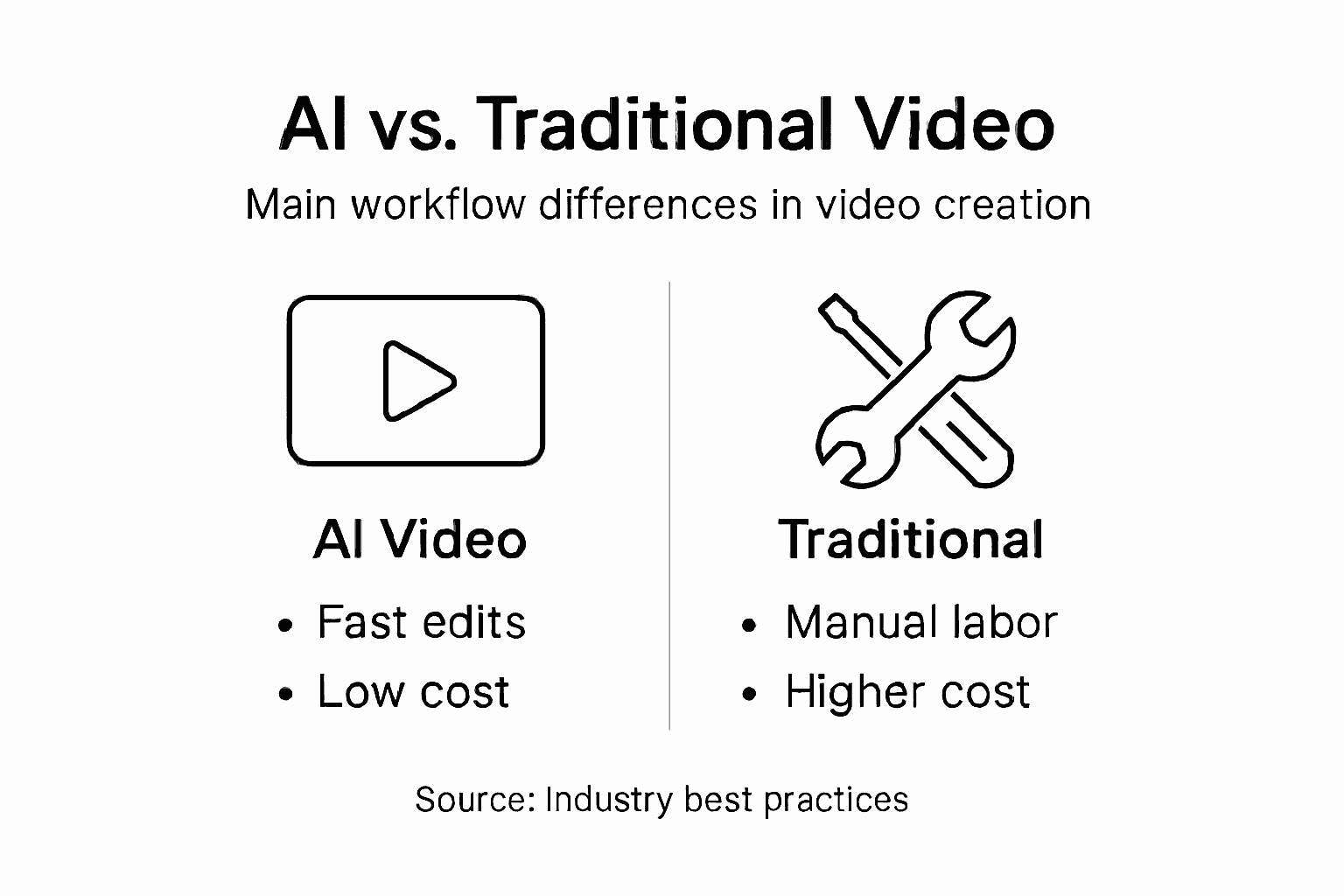
The most compelling aspect of this technological shift is the potential for hybrid approaches. Creators can leverage AI for repetitive tasks, initial concept generation, and technical refinement, while maintaining human oversight for critical creative decisions. This symbiotic relationship allows for unprecedented creative exploration, combining machine efficiency with human imagination.
Pro tip: Develop a workflow that integrates AI tools as collaborative assistants, using them to accelerate and expand creative possibilities rather than attempting full automation.
This side-by-side comparison highlights differences between AI and traditional video production:
| Aspect | AI Video Production | Traditional Methods |
|---|---|---|
| Time Efficiency | Rapid automation | Manual, time-intensive |
| Cost | Lower operational costs | High budget requirements |
| Creative Scaling | Fast content iteration | Slow, limited variations |
| Technical Barrier | User-friendly interfaces | Requires expert knowledge |
Unlock the Future of Video Production with AI
The article highlights key challenges in modern video creation such as time-consuming workflows, high technical barriers, and the need for creative flexibility. If you want to transform your creative production by harnessing AI-powered tools that automate script generation, scene management, and real-time editing, then Palmedor.ai is the solution designed exactly for you. By using advanced AI algorithms, Palmedor.ai streamlines complex video production steps so you can focus on your vision without the usual hassle or high costs.

Discover how easy it is to produce cinematic-quality videos from simple prompts and images. Whether you are creating brand films, social clips, or stories, Palmedor.ai’s intuitive platform empowers creators and professionals alike with smart presets, output customization, and hands-off scene creation. Take your first step toward revolutionizing your video projects now by exploring Palmedor.ai. Learn more about the power of AI video creation in our detailed FAQs and example cases to see it in action. Start crafting polished videos faster and smarter today.
Frequently Asked Questions
What are the benefits of using AI for video production?
AI streamlines the video production process by automating complex tasks like script generation, scene composition, and editing recommendations, significantly reducing time and costs while maintaining high-quality standards.
Can AI enhance creative workflows for less experienced creators?
Yes, AI democratizes video production, allowing creators of all skill levels to produce professional-grade content by lowering technical barriers and automating repetitive tasks, enabling more focus on storytelling and creative expression.
How does AI video generation compare to traditional methods?
AI video production offers faster completion times, lower operational costs, and increased creative flexibility compared to traditional methods, which, while offering nuanced storytelling, often require more time and resources.
What are some potential risks associated with AI video generation?
Some risks include computational expenses, potential algorithmic bias, data privacy concerns, and limited ability to capture complex emotional nuances, which necessitate ongoing human oversight and ethical considerations.