Voice Over Short Film: Transforming Storytelling With AI
Voice over short film essentials: Learn AI integration, creative workflows, casting choices, and common pitfalls for powerful, cinematic results.
Voice Over Short Film: Transforming Storytelling With AI

Most American and European filmmakers today face a common obstacle: conveying complex emotions with limited resources. Voice-over short films are reshaping the creative landscape by allowing creators to merge visual artistry with powerful narration. With more than 80 percent of independent productions now experimenting with AI-generated voice techniques, storytellers can add rich layers to their work without any specialized technical training. Discover how this approach empowers global creators to produce professional voice-over films more efficiently and creatively.
Table of Contents
- Defining Voice Over Short Films And Core Concepts
- Types Of Voice Over In Short Film Production
- AI Tools For Efficient Script And Voice Creation
- Casting Voices And Directing Performance Virtually
- Common Pitfalls And How To Avoid Mistakes
Key Takeaways
| Point | Details |
|---|---|
| Voice-Over Short Films Enhance Storytelling | Utilizing narration allows filmmakers to convey complex ideas and emotions that visuals may not express effectively. |
| Diverse Voice-Over Types Serve Different Purposes | Each voice-over type, from narrative commentary to internal monologue, plays a crucial role in shaping audience perception and engagement. |
| AI Tools Revolutionize Voice Creation | Modern AI technologies simplify script and voice generation, enabling independent creators to produce high-quality narratives without extensive resources. |
| Virtual Directing Expands Casting Potential | Remote voice directing techniques grant access to global talent and streamline creative collaboration, enhancing production flexibility. |
Defining Voice Over Short Films And Core Concepts
Voice-over short films represent a unique storytelling technique where narrative is delivered through offscreen commentary, offering filmmakers an innovative method to communicate complex ideas and emotional landscapes. Unlike traditional film formats, these productions utilize narration as a primary storytelling mechanism, transforming visual experiences through carefully crafted audio perspectives. Voice-over techniques provide creators with powerful tools to guide audience understanding and emotional engagement.
At its core, a voice-over short film involves narration that exists outside the immediate visual narrative, typically delivered by an unseen speaker who provides context, internal monologue, or descriptive commentary. This approach allows filmmakers to explore psychological depths, cultural nuances, and intricate storylines that might be challenging to communicate through dialogue or visual actions alone. Voice-over has evolved from early radio broadcasts into a sophisticated multimedia storytelling technique used across documentaries, narrative films, and experimental cinema.
The fundamental components of voice-over short films include:
- Narrative Voice: The primary storyteller providing perspective and context
- Audio Layering: Synchronized narration with visual content
- Emotional Resonance: Using vocal tone to convey deeper psychological states
- Narrative Flexibility: Ability to transcend traditional linear storytelling
Modern voice-over techniques leverage technological innovations, particularly AI tools, which enable creators to generate high-quality narrations with unprecedented ease and customization. These advancements democratize film production, allowing independent creators to craft professional-grade storytelling experiences without extensive audio recording infrastructure.
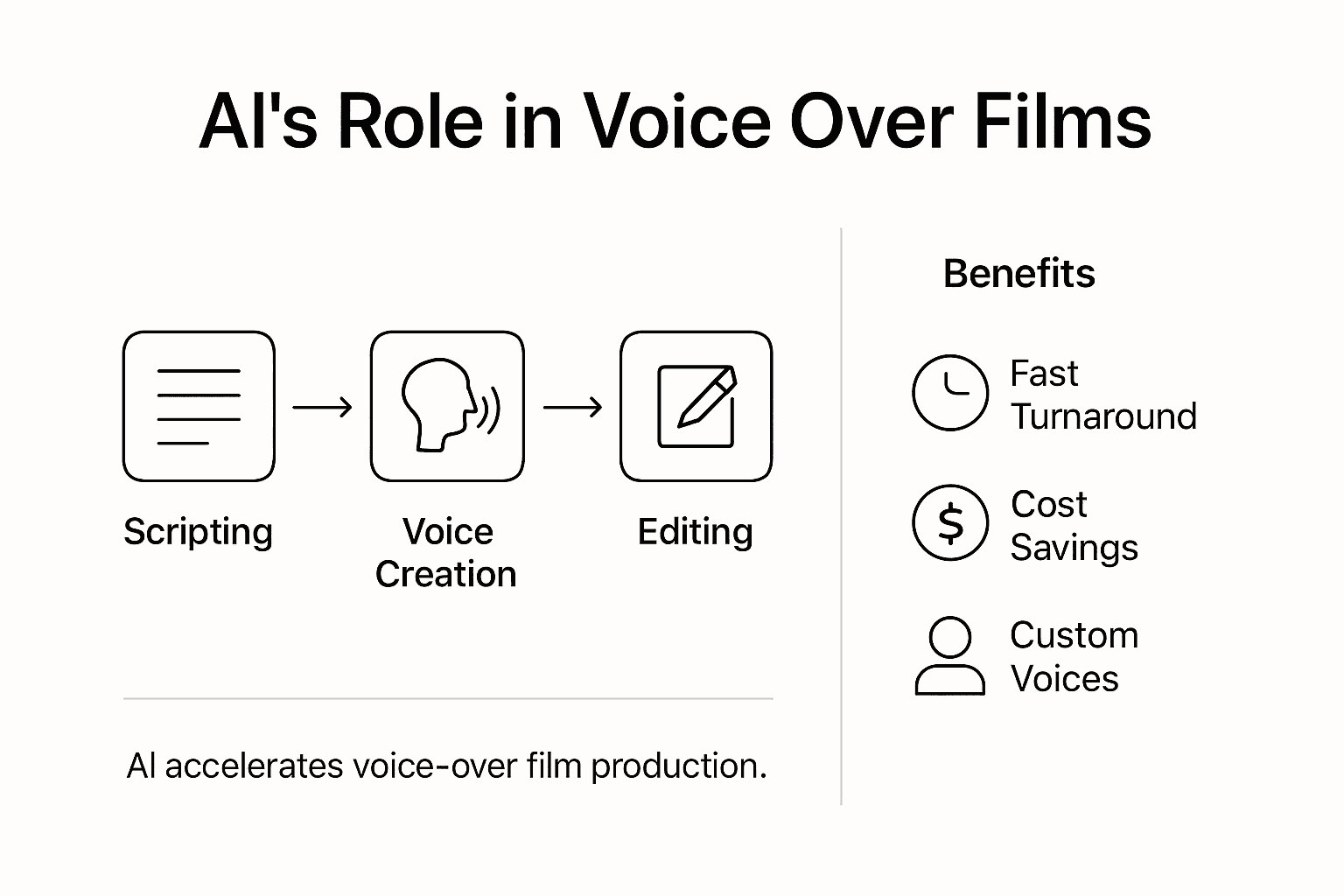
Pro tip: When developing a voice-over short film, focus on creating a narrative voice that complements rather than duplicates your visual storytelling, using audio to add depth and emotional complexity to your visual narrative.
Types Of Voice Over In Short Film Production
Voice-over techniques in short film production encompass a diverse range of approaches, each designed to enhance storytelling through unique narrative strategies. Filmmakers utilize multiple voice-over types that serve distinct narrative purposes, allowing for nuanced communication of ideas, emotions, and perspectives beyond traditional visual storytelling methods.
The primary categories of voice-over in short film production include:
- Narrative Voice-Over: A storyteller providing external commentary and context
- Character Internal Monologue: Revealing character thoughts and psychological states
- Documentary-Style Voice-Over: Providing informative and explanatory commentary
- Promotional Voice-Over: Creating emotional connection and audience engagement
- Asynchronous Voice-Over: Narrative audio that does not directly correspond to on-screen action
Short film voice-over techniques span multiple genres and production styles, ranging from commercial presentations to deeply personal narrative explorations. Each type requires careful consideration of tone, pacing, and narrative integration to effectively communicate the filmmaker's intended message and emotional landscape.
Here's a concise overview of voice-over types and their typical use in short films:
| Voice-Over Type | Typical Use Case | Impact on Storytelling |
|---|---|---|
| Narrative Voice-Over | Adds external perspective | Guides audience interpretation |
| Character Internal Monologue | Shows character psychology | Deepens emotional connection |
| Documentary-Style | Clarifies factual content | Enhances information delivery |
| Promotional Voice-Over | Builds engagement | Influences viewers emotionally |
| Asynchronous Voice-Over | Offers non-linear structure | Increases creative flexibility |
Modern voice-over production has been revolutionized by AI technologies, which enable creators to experiment with diverse vocal styles, accents, and emotional ranges. This technological advancement allows independent filmmakers to access professional-quality narration without extensive audio recording resources, democratizing the creative process and expanding storytelling possibilities.
Pro tip: Experiment with different voice-over styles during your pre-production phase, recording multiple narrative approaches to discover which best serves your short film's unique emotional and storytelling requirements.
AI Tools For Efficient Script And Voice Creation
Modern AI technologies for script and voice creation have revolutionized the way filmmakers develop narrative content, offering unprecedented capabilities in voice synthesis, script generation, and creative storytelling. These advanced tools provide independent creators with professional-grade resources that dramatically reduce production complexity and technical barriers, enabling more creators to bring their cinematic visions to life.
Key features of contemporary AI script and voice creation tools include:
- Automated Script Generation: Creating narrative frameworks based on genre and story concepts
- Voice Cloning: Reproducing specific vocal characteristics with minimal source material
- Emotional Tone Modeling: Adjusting vocal delivery to match narrative emotional states
- Multilingual Voice Synthesis: Supporting multiple languages and regional accents
- Real-Time Script Optimization: Suggesting narrative improvements and dialogue refinements
AI voice generator platforms now offer studio-quality voice synthesis with remarkable precision, allowing filmmakers to experiment with vocal styles, emotional ranges, and narrative perspectives. These technologies enable granular control over pitch, pacing, and sentiment, transforming the traditional voice-over production workflow and democratizing high-quality audio content creation.

The integration of machine learning algorithms has further enhanced these tools, enabling more nuanced and contextually appropriate voice generations. Creators can now access sophisticated voice synthesis technologies that understand narrative context, character motivations, and subtle emotional gradations, providing unprecedented creative flexibility for short film production.
Pro tip: Experiment with multiple AI voice generation tools to develop a comprehensive understanding of their unique strengths, creating a flexible workflow that leverages the most appropriate technology for each specific narrative requirement.
Casting Voices And Directing Performance Virtually
Virtual voice directing techniques have transformed the traditional approach to voice-over production, enabling filmmakers to collaborate seamlessly across geographical boundaries. Modern creators can now access global voice talent, coordinate complex performances, and achieve professional-quality recordings without requiring physical studio presence, fundamentally reshaping the voice-over creative process.
Key strategies for effective virtual voice casting and direction include:
- Comprehensive Performance Briefs: Detailed character and narrative context documentation
- High-Quality Remote Recording Tools: Platforms supporting professional audio transmission
- Real-Time Performance Feedback: Interactive direction through digital collaboration channels
- Emotional Tone Mapping: Precise guidance on character sentiment and delivery
- Cultural Context Sensitivity: Understanding nuanced vocal performance requirements
Remote voice actor collaboration technologies have dramatically expanded creative possibilities, integrating advanced communication platforms that support high-fidelity audio transmission and instantaneous performance adjustments. These digital solutions enable directors to provide granular feedback, demonstrate vocal techniques, and iteratively refine performances with unprecedented precision and efficiency.
AI-powered tools now complement traditional virtual directing methods, offering advanced features like emotional analysis, accent verification, and performance optimization. Filmmakers can leverage machine learning algorithms to assess vocal consistency, suggest performance variations, and ensure that voice-over recordings align perfectly with narrative requirements and artistic vision.
Compare virtual and in-person voice-over directing methods:
| Aspect | Virtual Voice Directing | In-Person Directing |
|---|---|---|
| Talent Access | Global, remote collaboration | Local, limited pool |
| Cost | Minimizes travel expenses | Typically higher |
| Feedback Speed | Real-time digital instructions | Immediate, hands-on review |
| Technical Needs | Stable internet, digital tools | Professional studio equipment |
Pro tip: Create a comprehensive digital performance brief with reference audio, character background, and specific emotional trajectory to help voice actors understand the nuanced requirements of your virtual voice-over project.
Common Pitfalls And How To Avoid Mistakes
Audio production challenges in voice-over short films can derail even the most promising creative projects, making understanding potential pitfalls crucial for independent filmmakers. Navigating these potential obstacles requires a strategic approach that anticipates technical, creative, and performance-related complications before they compromise the overall narrative quality.
Key potential pitfalls in voice-over production include:
- Talent Misalignment: Selecting voice actors who do not match character requirements
- Technical Audio Limitations: Poor recording quality from inadequate equipment
- Unclear Performance Directions: Insufficient context for voice actors
- Emotional Inconsistency: Mismatched vocal tone and narrative intent
- Post-Production Editing Challenges: Insufficient raw recording flexibility
Successful voice-over production demands meticulous preparation and a comprehensive understanding of potential technical and creative challenges. Filmmakers must develop robust pre-production strategies that include detailed character profiles, precise performance guidelines, and comprehensive technical specifications to mitigate potential recording complications.
Artificial intelligence technologies are increasingly providing sophisticated solutions to traditional voice-over production challenges. Machine learning algorithms can now help predict potential performance issues, suggest voice talent matches, and provide real-time audio quality assessments, enabling creators to address potential problems before they impact the final production.
Pro tip: Create a comprehensive pre-production checklist that includes technical requirements, performance expectations, and potential contingency plans to systematically address and prevent common voice-over production mistakes.
Revolutionize Your Voice Over Short Film Production with AI
Creating voice-over short films involves complex challenges like matching vocal tone to narrative, managing asynchronous audio layers, and directing nuanced performances without traditional studio setups. The article highlights how AI-powered voice synthesis, automated script generation, and virtual directing can overcome these hurdles while enriching storytelling with emotional depth and narrative flexibility.
Palmedor.ai offers a seamless solution designed to transform your creative process. With powerful features such as smart script generation, scene management, and AI-driven audio integration, you can produce cinematic-quality voice-over short films without extensive technical expertise. Whether you need detailed voice casting descriptions or moodboards to guide your virtual voice actors, our platform simplifies every step of production, empowering creators to bring their stories to life faster and with greater precision.

Take the next step toward elevating your voice-over storytelling. Discover how easy it is to create professional cinematic videos from your ideas by exploring Palmedor.ai. Start crafting your unique voice-over short films today and experience the future of AI-powered video creation.
Frequently Asked Questions
What are voice-over short films?
Voice-over short films are productions where the narrative is delivered through offscreen commentary, allowing filmmakers to communicate complex ideas and emotions that might be difficult to convey through visuals alone. This technique utilizes narration as a primary storytelling mechanism.
How does AI improve voice-over production in short films?
AI enhances voice-over production by providing tools for automated script generation, voice cloning, and emotional tone modeling. These technologies enable filmmakers to create high-quality narrations quickly and efficiently without extensive audio recording requirements.
What are the different types of voice-over used in short films?
The different types of voice-over in short films include narrative voice-over, character internal monologue, documentary-style voice-over, promotional voice-over, and asynchronous voice-over. Each type serves distinct purposes to enhance storytelling and audience engagement.
What are common challenges faced in voice-over production?
Common challenges in voice-over production include talent misalignment, poor recording quality, unclear performance directions, emotional inconsistency, and post-production editing issues. Addressing these challenges requires thorough pre-production planning and understanding of technical requirements.