Video Companies Explained: Types, Workflow, and Risks
Comprehensive guide to video companies. Learn about types, production workflows, AI-driven innovation, costs, risks, and essential industry distinctions.
Video Companies Explained: Types, Workflow, and Risks

Over 80 percent of internet traffic is now driven by video content, showing just how vital video has become for businesses and creators alike. With so many companies competing for attention, understanding what sets video firms apart can mean the difference between a message that lands and one that gets lost. Get to know what video companies do best and why their expertise shapes the stories people watch every day.
Table of Contents
- Defining Video Companies And Core Functions
- Types Of Video Companies And Key Distinctions
- Modern Video Production Workflows Explained
- AI-Driven Video Creation Platforms And Impact
- Cost, Risks, And Common Industry Challenges
Key Takeaways
| Type of Company | Core Focus | Key Strengths | Typical Clients |
|---|---|---|---|
| Comprehensive Services | Video companies provide end-to-end solutions, from scripting to distribution, beyond mere recording. | They cater to various sectors, creating impactful video content for multiple platforms. | |
| Diverse Company Types | The video production landscape includes major studios, independent companies, corporate producers, and more, each with unique focuses. | Selecting the right type depends on project scale, budget, and audience engagement needs. | |
| Evolving Workflows | Modern video production involves a sophisticated, collaborative workflow with defined stages: pre-production, production, and post-production. | Technical proficiency and adaptive project management are essential for success in this dynamic environment. | |
| AI Integration | AI-driven platforms are transforming video production by enabling automated content generation and intelligent scene selection. | These technologies enhance creative processes, allowing human creators to focus on storytelling and innovation. |
Defining Video Companies And Core Functions
Video companies are specialized organizations dedicated to transforming creative concepts into compelling visual narratives. Video production encompasses a comprehensive range of services designed to craft engaging content across multiple platforms and purposes. According to Wikipedia, these companies manage critical stages including pre-production, production, and post-production, generating videos for entertainment, education, and corporate communication.
The core functions of video companies extend far beyond simple recording. These organizations typically provide end-to-end solutions that include:
- Scripting: Developing narrative frameworks and dialogue
- Conceptualization: Translating abstract ideas into visual stories
- Filming: Capturing high-quality video content using professional equipment
- Editing: Refining raw footage into polished, impactful presentations
- Distribution: Strategically sharing content across relevant platforms
Specialized video companies often focus on specific industry niches. Wikipedia highlights that corporate video production firms, for instance, concentrate on creating non-advertisement content for businesses. These specialized providers produce videos for internal communications, training programs, promotional materials, and investor relations, typically distributing content through company websites and social media channels.
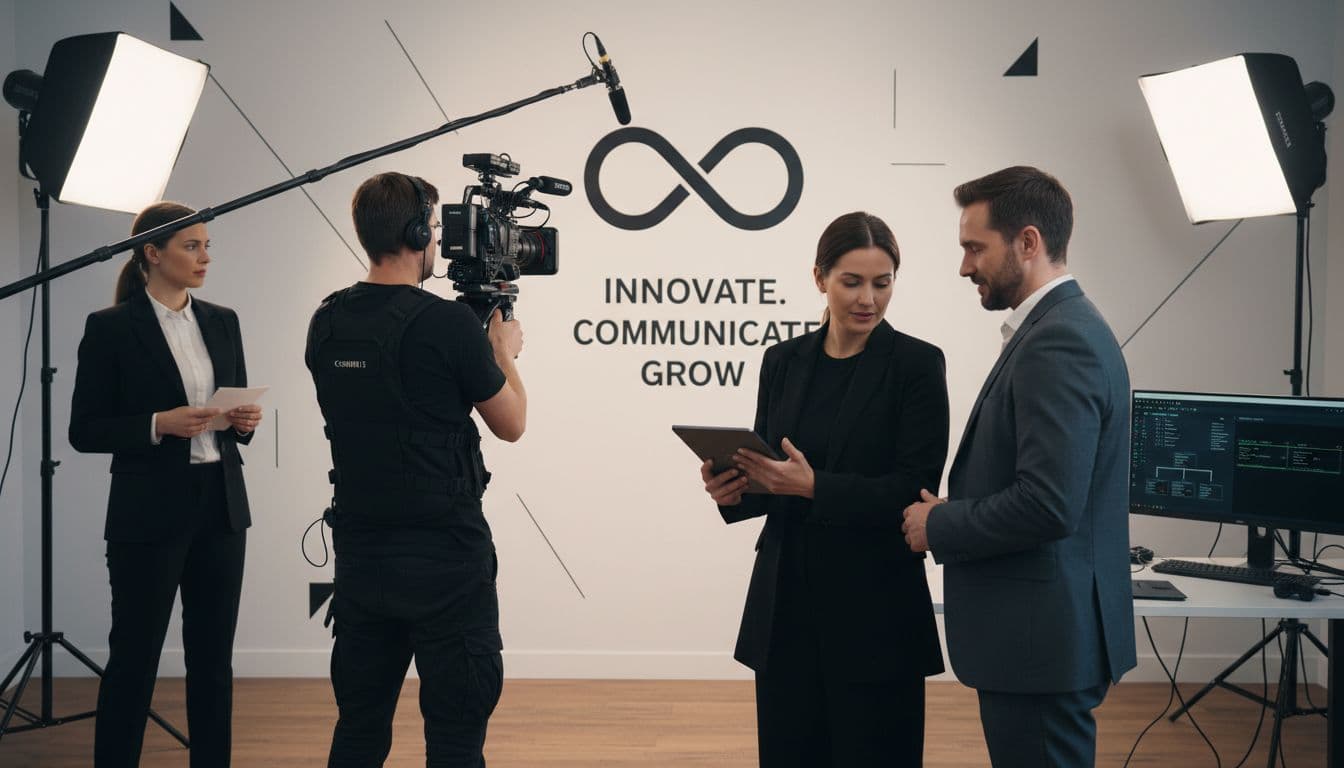
Understanding the nuanced landscape of video companies reveals a dynamic industry powered by creativity, technical expertise, and strategic communication. Whether producing a short social media clip or a comprehensive brand narrative, these organizations play a crucial role in transforming raw ideas into visually compelling stories that resonate with target audiences.
Types Of Video Companies And Key Distinctions
The video production landscape features diverse organizations with unique capabilities and strategic focuses. Major film studios represent one end of the spectrum, characterized by extensive resources and global reach. According to Wikipedia, these companies possess substantial infrastructure enabling them to produce, distribute, and market high-budget productions across international markets.
Video companies can be broadly categorized into several distinct types:
- Major Studios: Large-scale production houses with significant financial backing
- Independent Film Companies: Smaller organizations focusing on niche markets
- Corporate Video Producers: Specialized firms creating business-oriented content
- Advertising Production Houses: Companies dedicated to commercial and promotional videos
- Streaming Platform Producers: Organizations creating content specifically for digital platforms
Wikipedia highlights that independent film companies operate outside traditional studio systems, offering unique advantages. These organizations typically provide more creative freedom, targeting specific genres or audience segments. While working with comparatively limited budgets and distribution channels, they often generate innovative and critically acclaimed content that challenges mainstream narratives.
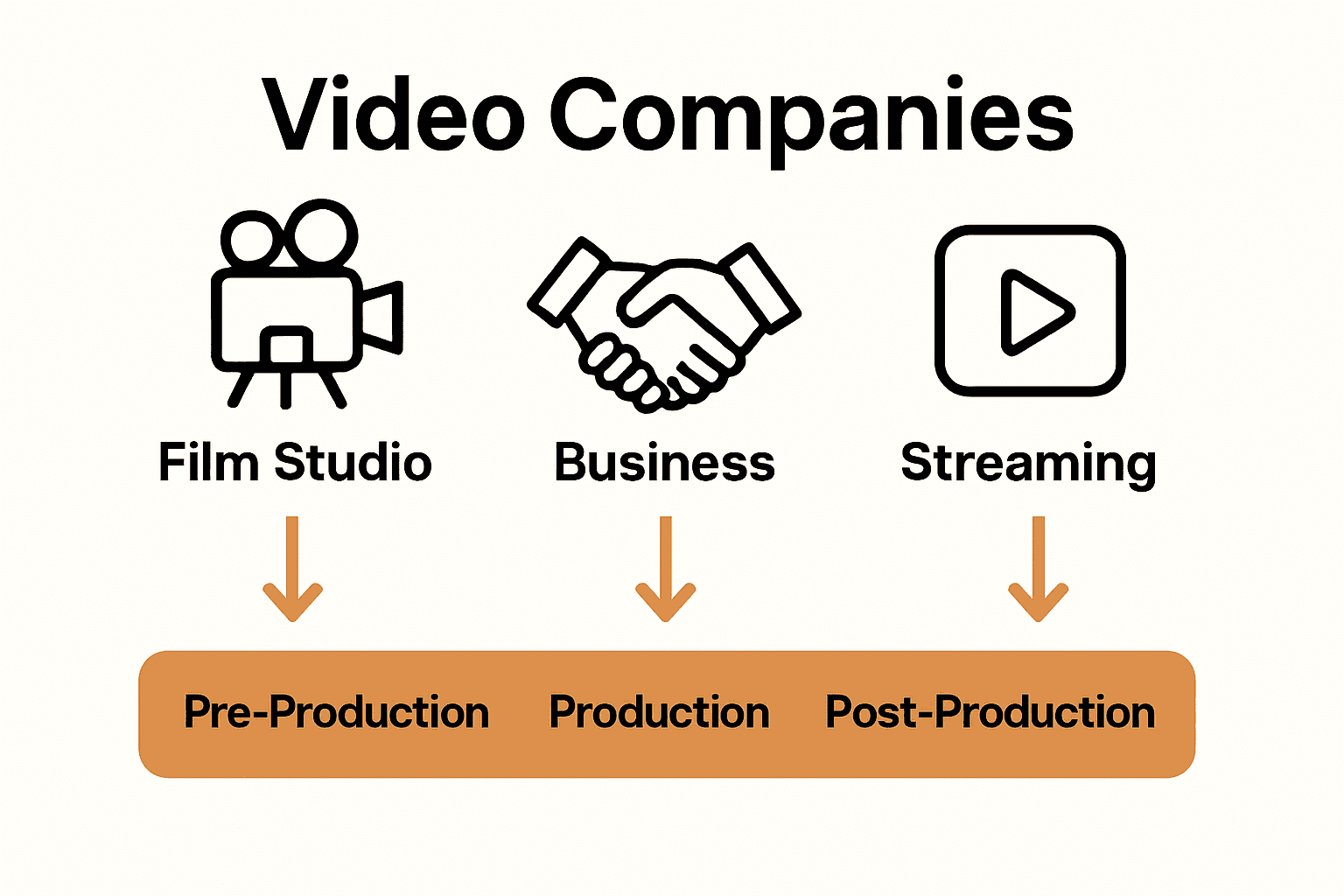
Each video company type brings distinctive strengths to the creative ecosystem. Major studios leverage massive production capabilities, while independent companies offer artistic innovation. Corporate producers focus on precise messaging, advertising firms craft compelling narratives, and streaming producers adapt to rapidly evolving digital consumption patterns. Understanding these variations helps creators and businesses select the most appropriate video production partner for their specific objectives.
Here's a comparison of major types of video companies and their key traits:
| Type of Company | Core Focus | Key Strengths | Typical Clients |
|---|---|---|---|
| Major Studios | Blockbuster films | Global reach, Large budgets, Extensive resources | Studios, Distributors |
| Independent Film Companies | Niche genres, Art innovation | Creative freedom, Unique storytelling | Indie filmmakers, Art houses |
| Corporate Video Producers | Business communications | Targeted messaging, Professional polish | Enterprises, Corporations |
| Advertising Production Houses | Commercials & promos | Marketing expertise, Brand storytelling | Agencies, Brands |
| Streaming Platform Producers | Digital-first content | Quick turnaround, Audience analytics | Online platforms, Streaming services |
Modern Video Production Workflows Explained
Video production has evolved into a sophisticated, multi-stage process that transforms creative concepts into compelling visual narratives. According to Wikipedia, modern workflows typically encompass three critical stages: pre-production, production, and post-production. Each stage plays a crucial role in ensuring the final video meets creative and technical standards.
The workflow stages break down into specific components:
Pre-Production Stage:
- Concept development
- Script writing
- Storyboarding
- Location scouting
- Talent casting
- Equipment and resource planning
Production Stage:
- Actual video and audio recording
- Directing talent
- Managing technical equipment
- Capturing primary visual content
Post-Production Stage:
- Video editing
- Sound mixing
- Visual effects integration
- Color grading
- Final content rendering
Wikipedia highlights the emergence of Electronic Field Production (EFP), a dynamic approach that emphasizes mobility and flexibility. EFP techniques allow video production teams to adapt to diverse location conditions while maintaining high-quality production standards. This method represents a significant shift from traditional studio-bound production, enabling creators to capture authentic environments and spontaneous moments.
Modern video production workflows are increasingly collaborative and technology-driven. Teams now leverage advanced digital tools, cloud-based collaboration platforms, and sophisticated editing software to streamline processes. The boundaries between production stages have become more fluid, with rapid iterations and real-time feedback becoming standard practices. Successful video production now demands not just creative vision, but also technical proficiency and adaptive project management skills.
AI-Driven Video Creation Platforms And Impact
Artificial intelligence is rapidly revolutionizing video production, transforming traditional creative processes with unprecedented efficiency and innovation. According to research from arXiv, emerging AI-driven platforms like the 'Smart Director' system can now automatically analyze multi-view video inputs, detecting events and selecting optimal camera angles to mimic human directing processes.
Key capabilities of AI-driven video creation platforms include:
- Automated Content Generation: Creating videos with minimal human intervention
- Intelligent Scene Selection: Analyzing and selecting the most compelling visual perspectives
- Real-time Editing: Dynamic content adjustment based on predefined parameters
- Cost Reduction: Minimizing production time and resource expenditure
- Scalable Production: Generating multiple video variants simultaneously
Synthesia highlights that these platforms are fundamentally transforming video production landscapes by enabling automated content generation across diverse sectors. Corporate communications, training programs, and marketing campaigns now leverage AI technologies to produce sophisticated visual narratives with unprecedented speed and precision.
The emergence of AI-driven video platforms represents more than a technological trend. It signifies a profound shift in creative production, where machine learning algorithms collaborate with human creativity. By automating technical aspects of video creation, these platforms empower creators to focus on strategic storytelling, conceptual innovation, and emotional resonance. The future of video production is not about replacing human creativity, but augmenting and accelerating it through intelligent technological partnerships.
Cost, Risks, And Common Industry Challenges
Video production represents a complex landscape of financial considerations and potential risks that can significantly impact project success. According to Chapla, organizations face critical decisions between in-house production and outsourcing, each carrying distinct financial implications. In-house video production demands substantial upfront investments in equipment and personnel, with ongoing expenses for maintenance and continuous training.
Key financial and operational challenges in video production include:
- Equipment Costs: High-end cameras, editing software, and technical infrastructure
- Talent Acquisition: Recruiting skilled professionals with specialized expertise
- Technical Training: Continuous skill development and technology updates
- Project Scalability: Managing resource allocation across varying project sizes
- Quality Consistency: Maintaining professional standards across different productions
LocalEyesIT highlights that selecting the right production approach depends on critical factors such as project scale, budget constraints, and desired quality. While videographers might be suitable for smaller, budget-conscious projects, full video production companies are better equipped to handle complex, large-scale productions that require comprehensive technical and creative resources.
Navigating the video production landscape requires strategic planning and risk mitigation. Successful creators understand that beyond technical capabilities, managing financial expectations, maintaining flexible resource allocation, and continuously adapting to technological advancements are fundamental to sustainable video production. The most effective organizations treat video production not just as a creative endeavor, but as a sophisticated business strategy that balances artistic vision with financial pragmatism.
Simplify Your Video Production Journey with AI Power
The article highlights the complexities and risks inherent in traditional video production workflows from scripting to post-production editing. If you find yourself overwhelmed by equipment costs, managing talent, or struggling to keep quality consistent while balancing budgets and deadlines, you are not alone. Many creators and businesses face these challenges, especially when trying to produce professional-grade videos with limited resources and technical skills. From concept development to intelligent scene selection, modern video production demands smarter solutions that reduce costs and speed up delivery without sacrificing quality.

Discover how Palmedor.ai reshapes video creation for professionals and creators alike. This AI-driven platform transforms your ideas and simple prompts into cinematic videos with minimal effort. Enjoy features such as automatic script generation, smart scene management, and flexible output customization designed to streamline every stage of production so you can focus on storytelling instead of technical headaches. Whether you are producing brand films or social clips, Palmedor.ai helps you overcome the typical financial and operational risks associated with in-house or outsourced production.
Start your effortless video creation experience today by visiting https://palmedorai.com and see firsthand how advanced AI technology redefines what it means to bring your visual stories to life. Don’t let conventional production challenges hold back your creativity—embrace innovation now and deliver stunning results faster and easier.
Frequently Asked Questions
What services do video companies typically provide?
Video companies offer a range of services, including scripting, conceptualization, filming, editing, and distribution, to produce engaging content across various platforms.
What are the different types of video companies?
Video companies can be categorized into major studios, independent film companies, corporate video producers, advertising production houses, and streaming platform producers, each focusing on specific areas of video production.
What are the key stages in the video production workflow?
The video production workflow generally includes three stages: pre-production (planning and preparation), production (actual filming), and post-production (editing and finalizing the video).
How can AI impact the video production process?
AI-driven video creation platforms can automate content generation, enhance scene selection, and reduce production costs, enabling creators to focus on storytelling and innovation.