Understanding Frame Rate Explained for Video Creators
Frame rate explained: Learn its importance, impact on visuals, and how it shapes video quality for creators and marketers.
Understanding Frame Rate Explained for Video Creators
Frame rate is the heartbeat of every video, deciding how smooth or jittery motion feels from scene to scene. You might think that a higher number always means better quality, but not so fast. Even Hollywood blockbusters still use 24 frames per second, a number set nearly a century ago, for its unique, cinematic magic. The real art is picking the right frame rate to suit the mood and the message—not just chasing bigger numbers.
Table of Contents
- What Is Frame Rate And Its Role In Video Quality?
- Why Frame Rate Matters For Different Types Of Content
- How Frame Rate Influences Viewer Experience
- Key Concepts: Frame Rate Standards And Their Uses
- Real-World Applications Of Frame Rate In Media Production
Quick Summary
| Takeaway | Explanation |
|---|---|
| Frame rate directly impacts viewer emotion. | Different frame rates trigger varied emotional responses, influencing viewer engagement and narrative connection. |
| Frame rates vary by content type. | Selecting a frame rate depends on the genre; cinema often uses 24 fps, while sports might utilize 60 fps for clarity. |
| Higher frame rates enhance realism. | Higher frame rates can provide smoother motion but may disrupt narrative immersion with a hyper-real effect. |
| Understand frame rates for effective storytelling. | Frame rate selection is crucial for creating the desired psychological and emotional impact within visual content. |
| Balance technical and creative choices. | Professional creators must align technical specifications with storytelling intent to engage audiences effectively. |
What is Frame Rate and Its Role in Video Quality?
Frame rate represents the number of individual images or frames displayed per second in a video, serving as a fundamental parameter that significantly impacts visual perception and overall video quality. This technical metric determines how smoothly motion appears and directly influences viewer experience across different media platforms.
Understanding Frame Rate Basics
At its core, frame rate is measured in frames per second (fps), representing how many still images are sequentially shown to create the illusion of motion. The human visual system perceives these rapid image transitions as continuous movement. Lower frame rates result in choppy, stuttering visuals, while higher frame rates provide smoother, more fluid motion.
Typical frame rate standards vary across different media and use cases:
- 24 fps: Standard for traditional cinema and film production
- 30 fps: Common for television broadcasting and standard video content
- 60 fps: Preferred for gaming, sports broadcasting, and high motion videos
- 120 fps: Used in advanced slow motion and professional sports coverage
Video Quality and Perceptual Dynamics
Frame rate fundamentally interacts with human visual perception. According to Carnegie Mellon University's Human Computer Interaction research, our eyes and brain process motion differently based on frame rate complexity. Professional video creators must understand how frame rate influences viewer engagement and emotional response.
The relationship between frame rate and perceived motion is nuanced. While higher frame rates provide smoother motion, they can sometimes create an unnaturally hyper realistic effect known as the "soap opera effect". This demonstrates that technical capability does not always translate directly into aesthetic preference.
Understanding frame rate requires balancing technical specifications with creative intent. Whether creating cinematic experiences, marketing content, or documentary footage, selecting the appropriate frame rate becomes a critical decision in visual storytelling.
For video creators, mastering frame rate means understanding not just the technical metrics, but how these measurements translate into viewer experience and emotional impact.
Why Frame Rate Matters for Different Types of Content
Frame rate selection is far more than a technical decision. It profoundly influences how audiences perceive and emotionally connect with visual content, making it a critical creative choice for video professionals across various genres and platforms.
Genre Specific Frame Rate Considerations
Each content type demands a unique frame rate approach that optimizes visual storytelling and audience engagement. Professional creators strategically select frame rates to achieve specific aesthetic and technical objectives.
Content genres require distinctive frame rate treatments:
- Film and Cinema: Traditionally uses 24 fps for a cinematic, slightly dream like visual quality
- Sports Broadcasting: Utilizes 60 fps or higher to capture rapid motion with crystal clear detail
- Gaming Content: Prefers 60 fps and above to ensure smooth gameplay representation
- Documentary: Often uses 24 fps to maintain a naturalistic, documentary style aesthetic
- Commercial Advertising: Varies between 24 to 30 fps depending on emotional impact desired
Technical Performance and Viewer Experience
Frame rate directly impacts technical performance and viewer perception. According to BBC Research and Development, different frame rates create distinct psychological responses. High frame rates provide exceptional motion clarity but can sometimes feel hyper realistic, potentially disrupting narrative immersion.
Video content creators must balance technical capabilities with storytelling intent. A documentary filmmaker might prioritize natural motion representation, while a sports broadcaster needs maximum detail and smoothness. This nuanced selection process requires understanding how frame rate influences viewer psychology and technical performance.
Understanding frame rate means recognizing it as a powerful visual language. Beyond mere technical specification, frame rate becomes a creative tool for shaping audience experience, emotional engagement, and narrative impact across diverse content types.
How Frame Rate Influences Viewer Experience
Frame rate transcends technical specification and directly shapes how viewers emotionally and perceptually engage with visual content. Its subtle yet profound impact determines the psychological and physiological response audiences have to moving images.
Psychological Perception of Motion
The human visual system processes motion through complex neurological mechanisms. Different frame rates trigger varying cognitive and emotional responses, creating distinct viewing experiences. Lower frame rates can produce a more dreamlike, artistic feeling, while higher frame rates generate heightened realism and immediate sensory engagement.
Key psychological responses to frame rate include:
- Emotional Distance: Lower frame rates create a sense of cinematic abstraction
- Immersion Levels: Higher frame rates generate increased viewer involvement
- Narrative Perception: Frame rate subtly influences story comprehension and emotional connectivity
- Sensory Processing: Different rates activate varied neurological motion tracking mechanisms
Technical Impact on Viewer Engagement
According to IEEE Visualization Research, frame rate significantly influences how viewers perceive motion and realism in digital content. The research demonstrates that higher frame rates make movements appear more lifelike, particularly crucial in immersive experiences like virtual reality and interactive media.
Viewers subconsciously process motion smoothness, with frame rate acting as an invisible language of visual communication. A sports broadcast at 60 fps feels dramatically different from a film shot at 24 fps, even when viewers cannot consciously articulate the technical difference.
Professional content creators must understand that frame rate is more than a technical parameter. It is a nuanced tool for emotional storytelling, capable of subtly guiding viewer perception, engagement, and overall viewing experience across diverse media platforms.

Key Concepts: Frame Rate Standards and Their Uses
Frame rate standards represent critical technical specifications that define visual media quality across different platforms and production contexts. These standardized measurements provide a universal language for video creators, enabling consistent communication and technical compatibility.
Global Frame Rate Conventions
Different regions and industries have developed unique frame rate standards based on technological infrastructure, broadcast requirements, and cultural visual preferences. Understanding these conventions helps video creators make informed production decisions.
Key international frame rate standards include:
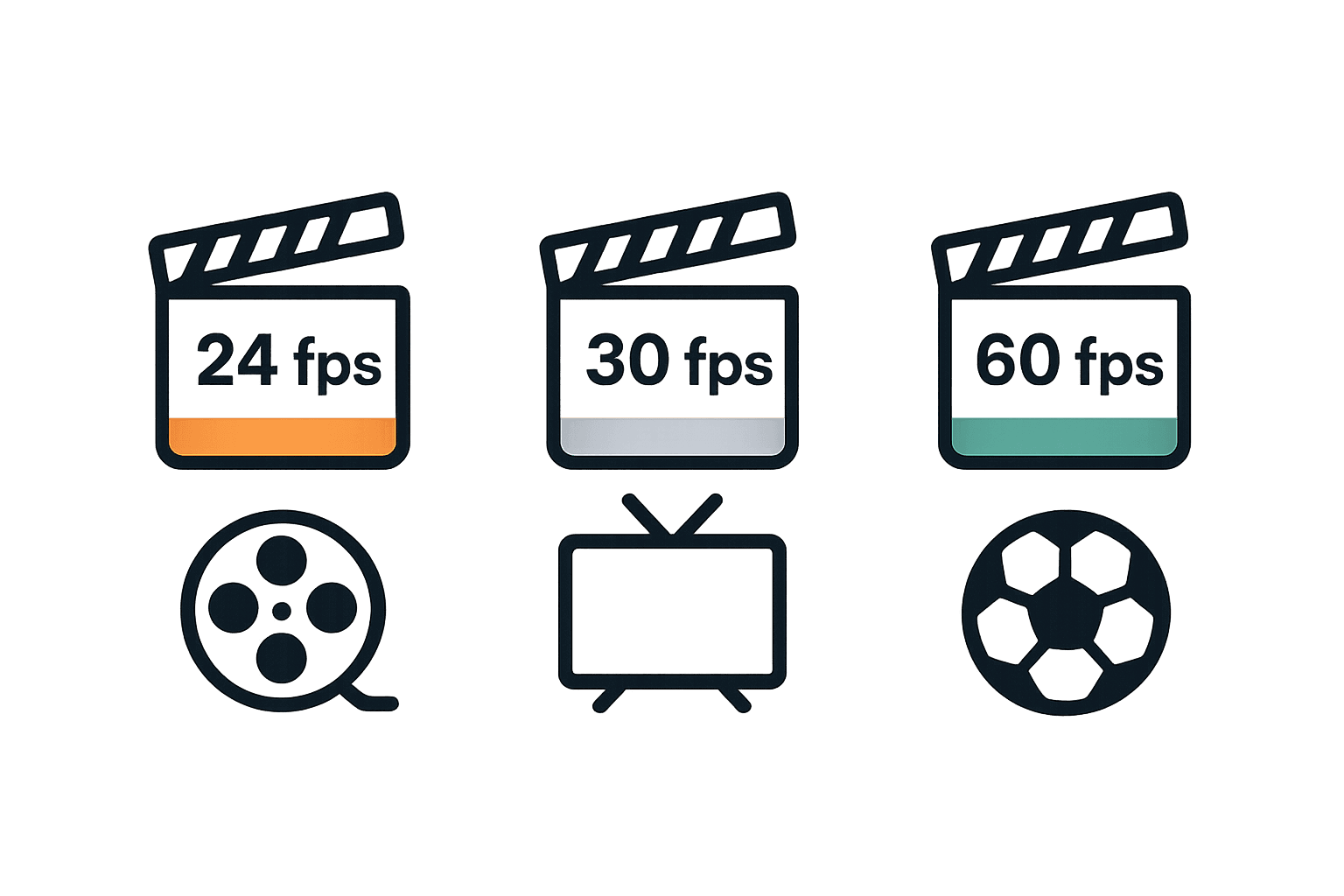
- 24 fps: Traditional cinema standard originating from analog film technology
- 25 fps: European broadcast standard based on PAL television systems
- 30 fps: North American broadcast standard derived from NTSC television
- 50 fps: High definition broadcast standard in many European countries
- 60 fps: Advanced digital video standard for sports and high motion content
Technical Compatibility and Production Considerations
Frame rate selection involves complex interactions between hardware capabilities, content type, and distribution platforms. According to Society of Motion Picture and Television Engineers, professional video creators must consider multiple technical parameters when choosing frame rates.
Production environments demand nuanced frame rate approaches. Broadcast television requires different technical specifications compared to digital streaming platforms. Gaming content prioritizes high frame rates for smooth motion, while cinematic productions often prefer lower frame rates to maintain a traditional film aesthetic.
Understanding frame rate standards means recognizing them as more than mere technical specifications. They represent a sophisticated technological language that bridges creative vision with technical execution, enabling video creators to communicate complex visual narratives across diverse global platforms.
Real-World Applications of Frame Rate in Media Production
Frame rate selection is a strategic decision that extends far beyond technical specifications, serving as a critical creative tool for video professionals across diverse media production environments. Each industry segment leverages frame rate uniquely to achieve specific visual communication objectives.
Industry Specific Frame Rate Strategies
Professional media production demands sophisticated frame rate approaches tailored to specific content requirements. Different sectors utilize frame rates as a nuanced storytelling mechanism, transforming technical parameters into powerful visual communication tools.
Key industry frame rate applications include:
- Film Production: Maintains traditional 24 fps for cinematic storytelling
- Sports Broadcasting: Utilizes 50 to 60 fps for capturing rapid motion
- Video Game Streaming: Requires 60 fps or higher for smooth gameplay representation
- Scientific Visualization: Uses variable high frame rates for detailed motion analysis
- Virtual Reality: Demands high frame rates to minimize motion sickness
Technical Performance and Creative Expression
According to European Broadcasting Union Technical Documentation, live sports broadcasts strategically employ high frame rates to capture fast-moving action with exceptional clarity. Professional video creators understand that frame rate is not merely a technical parameter but a sophisticated visual language that bridges technological capability with creative intent.
Frame rate selection involves complex interactions between technological infrastructure, creative vision, and audience expectation. A documentary filmmaker might prioritize naturalistic motion representation, while a video game developer needs ultra smooth visual performance. This nuanced approach transforms frame rate from a mere technical specification into a powerful storytelling mechanism.
Ultimately, mastering frame rate means understanding its role as a dynamic creative tool. By strategically selecting frame rates, video professionals can shape viewer perception, emotional engagement, and narrative impact across diverse media platforms.
Ready to Master Frame Rate With Effortless Video Creation?
Are you struggling to balance technical choices like frame rate with your creative vision? This article highlighted how picking the right frame rate changes everything, from cinematic feel to viewer engagement. Many creators know what they want to achieve, but the technical details such as scene management and output customization become stumbling blocks. The desire to translate complex ideas into high-quality videos often gets lost in the process.

Let Palmedor.ai transform your workflow. Describe your vision or upload your images and let our AI handle script generation, frame rate settings, and professional rendering. You focus on your story, and we ensure every technical detail is optimized. Ready to experience seamless video creation from prompt to final cut? Visit our FAQ to see how it works or get started at https://palmedorai.com for cinematic results now.
Frequently Asked Questions
What is frame rate?
Frame rate refers to the number of individual frames displayed per second in a video, measured in frames per second (fps). It affects how smooth motion appears in videos and influences viewer experience.
Why does frame rate matter in video production?
Frame rate is crucial in video production as it affects visual storytelling, viewer engagement, and emotional response. Different genres require specific frame rates to optimize audience perception and technical performance.
How does frame rate impact viewer experience?
Frame rate directly shapes how viewers perceive motion and realism. Lower frame rates create a cinematic feel, while higher frame rates can enhance realism and immersion. The choice influences emotional connectivity and narrative comprehension.
What are the standard frame rates for different types of content?
Common frame rates include 24 fps for film, 30 fps for television, 60 fps for sports and gaming, and higher rates for immersive experiences like virtual reality. Selecting the appropriate frame rate aligns with content type and audience expectations.