Script Template for Video Production: Essential Guide
Script template for video production explained: core elements, key formats, practical usage, workflow integration, and common pitfalls in this complete guide.
Script Template for Video Production: Essential Guide

Most american video producers know that a strong script is the backbone of great content, yet over 80 percent of projects run into delays from unclear planning. Whether crafting a commercial or a short film, having a clear roadmap can decide if your message lands or gets lost. Understanding script templates gives you the power to turn creative energy into organized, compelling storytelling that stands out in a crowded digital space.
Table of Contents
- What Is A Script Template For Video Production
- Types Of Script Templates And Key Formats
- Essential Elements In Effective Script Templates
- Integrating Script Templates Into Video Workflows
- Common Pitfalls And Best Practices
Key Takeaways
| Point | Details |
|---|---|
| Purpose of Script Templates | Script templates serve as strategic blueprints that convert creative ideas into structured video narratives, enhancing collaboration among production teams. |
| Types of Script Templates | Various script formats exist, such as audio-visual, structured, and interview scripts, each tailored to specific production needs. |
| Essential Elements | Effective script templates include critical components like the title, story arc, and dialogue framework, ensuring focused and intentional production. |
| Workflow Integration | Integrating templates into video workflows enhances efficiency and communication, necessitating a cultural shift toward structured collaboration. |
What Is a Script Template for Video Production
A script template is the strategic blueprint that transforms creative concepts into structured visual narratives. According to demand metric research, a video script template represents a comprehensive framework designed to outline the key components of a video's narrative, including critical elements like title, story arc, initial hook, and primary messages.
Think of a script template as your production roadmap. It breaks down complex storytelling into systematic sections that guide filmmakers, marketers, and content creators through the precise steps of video development. These templates typically include dedicated spaces for scene descriptions, dialogue, visual directions, timing annotations, and critical narrative transitions. By providing a standardized structure, script templates help streamline communication between creative teams, reduce potential misunderstandings, and ensure everyone involved understands the project's vision.
Effective script templates go beyond simple text organization. They serve as collaborative tools that enable rapid prototyping and efficient iteration. Whether you're producing a 30-second commercial, a training video, or a short film, a well-designed template allows you to:
- Quickly map out narrative flow
- Synchronize visual and audio elements
- Track scene-by-scene progression
- Facilitate smoother production workflows
- Create consistent storytelling experiences
Ultimately, a script template is more than a document - it's a strategic framework that transforms abstract creative ideas into actionable, visual storytelling blueprints. By providing structure without stifling creativity, these templates empower video producers to bring their most compelling narratives to life with precision and clarity.
Types of Script Templates and Key Formats
Video production demands versatility, which is why multiple script template formats exist to address different creative and technical requirements. Audio-visual scripts represent one of the most comprehensive formats, meticulously coordinating visual and sound elements to create a seamless narrative experience.

The primary script template types can be categorized into distinct professional frameworks. Structured scripts provide a linear approach, breaking down content into precise sections with clear narrative progression. Interview scripts offer more flexibility, creating space for spontaneous dialogue while maintaining an overarching conversational structure. Storyboard templates focus heavily on visual planning, using graphic representations to map out scene compositions, camera angles, and sequential storytelling.
Each script template type serves unique production needs:
- Audio-Visual Scripts: Synchronize visual and sound elements precisely
- Structured Scripts: Provide clear narrative progression
- Interview Scripts: Allow conversational flexibility
- Storyboard Templates: Visualize scene compositions
- Commercial Scripts: Highlight product messaging
- Narrative Scripts: Support storytelling arcs
Professional video creators understand that selecting the right script template can dramatically impact production efficiency. The template you choose should align with your project's specific goals, target audience, and creative vision. By matching your content strategy with an appropriate script format, you transform raw ideas into compelling visual narratives that resonate with viewers.
Essential Elements in Effective Script Templates
According to demand metric research, effective script templates incorporate critical components that transform abstract concepts into structured narratives. These essential elements serve as the foundational blueprint for compelling video content, ensuring that every aspect of production remains focused and intentional.
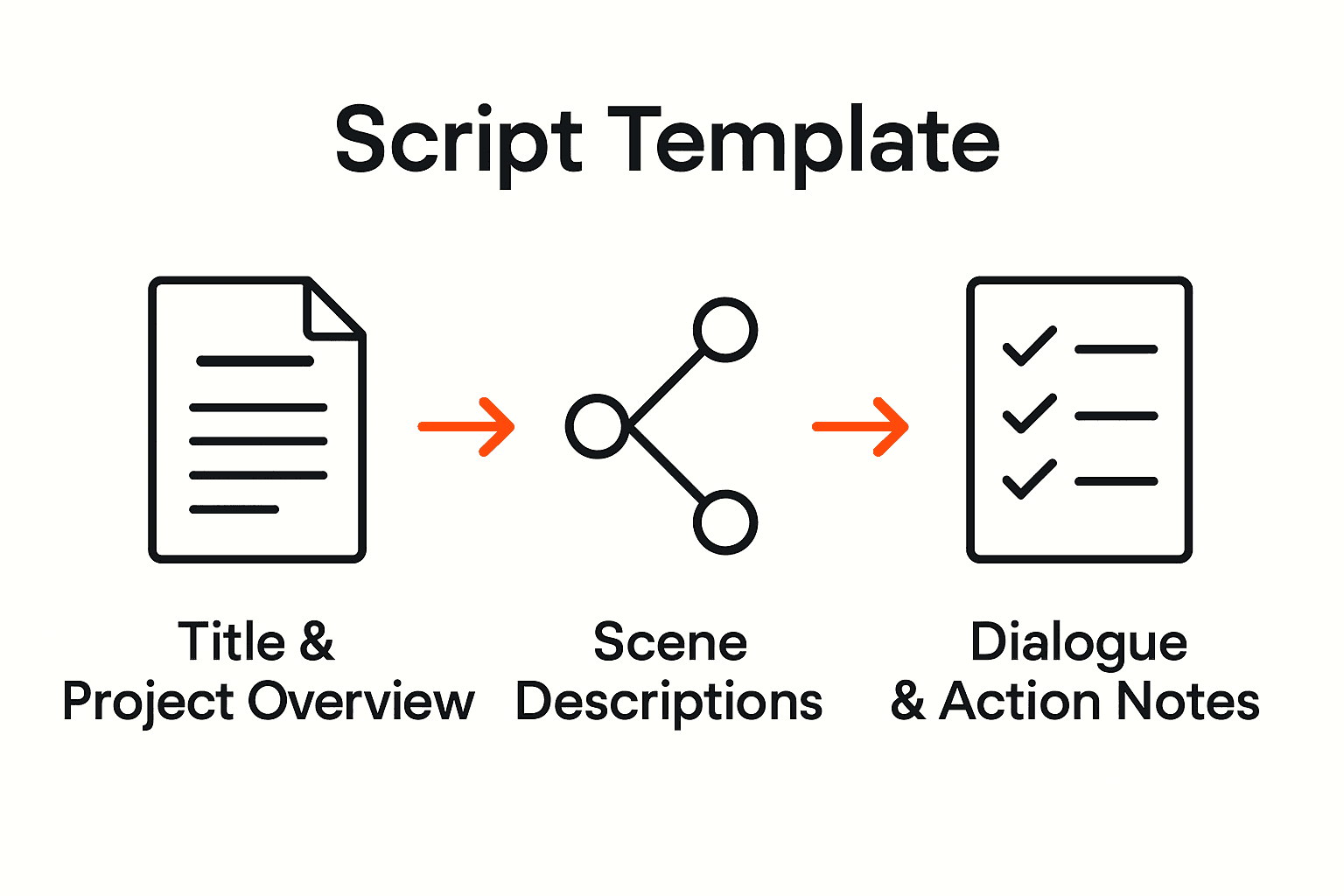
The core elements of a robust script template typically include strategic narrative components that guide the entire production process. These fundamental building blocks encompass the project's title, overarching story structure, compelling hook, specific purpose, detailed content outline, and anticipated outcomes. By meticulously defining each of these elements, video creators establish a clear roadmap that aligns creative vision with practical execution.
Key essential elements in an effective script template include:
- Title and Project Overview: Clearly define the video's core concept
- Story Arc: Establish narrative progression and emotional journey
- Hook: Create an engaging entry point that captures audience attention
- Purpose Statement: Articulate the video's primary objectives
- Scene Descriptions: Provide detailed visual and audio directions
- Dialogue Framework: Outline spoken content and character interactions
- Timing Annotations: Mark precise sequence durations and transitions
- Outcome Expectations: Define desired viewer responses and actions
Ultimately, a well-crafted script template acts as more than just a document - it's a strategic communication tool that bridges creative imagination with systematic production. By incorporating these essential elements, video creators can transform raw ideas into structured, purposeful narratives that effectively communicate their intended message with precision and impact.
Integrating Script Templates Into Video Workflows
Integrating script templates into video production workflows represents a strategic approach to streamlining content creation processes. Workflow integration transforms script templates from static documents into dynamic collaborative tools that align creative vision with technical execution.
Utilizing video script templates dramatically enhances production efficiency by providing a structured framework for content planning, coordination, and execution. Professional teams leverage these templates to establish clear communication channels, define precise roles, and create a shared understanding of project objectives. By implementing a standardized template approach, video production teams can reduce miscommunication, minimize revision cycles, and accelerate overall project timelines.
Key strategies for effective script template workflow integration include:
- Collaborative Annotation: Enable real-time feedback and markup
- Version Control: Implement systematic document tracking
- Cross-Department Alignment: Ensure consistent understanding across teams
- Digital Asset Mapping: Link script elements to specific production resources
- Modular Content Design: Create flexible template structures
- Performance Tracking: Integrate metrics and production benchmarks
Successful workflow integration requires more than just adopting a template. It demands a cultural shift towards structured, transparent communication. By treating script templates as living documents that evolve throughout production, creative teams transform traditional linear processes into dynamic, interconnected systems that maximize both creative potential and operational efficiency.
Common Pitfalls and Best Practices
Avoiding common mistakes in script template development requires a strategic approach that balances creativity with systematic planning. Script template pitfalls often emerge from unclear messaging, disorganized structures, and misaligned production objectives, creating significant challenges for video creators seeking to deliver compelling content.
Professional video producers recognize that effective script templates demand meticulous attention to detail and a comprehensive understanding of potential communication barriers. The most frequent mistakes include overly complex language, lack of clear narrative progression, insufficient visual-audio coordination, and ambiguous purpose statements. Successful creators develop script templates that provide flexibility while maintaining a structured framework that guides the entire production process.
Key pitfalls and corresponding best practices include:
- Unclear Messaging
- Pitfall: Vague or convoluted language
- Best Practice: Use clear, direct communication
- Inconsistent Narrative Flow
- Pitfall: Disjointed scene transitions
- Best Practice: Establish logical story progression
- Misaligned Objectives
- Pitfall: Scripts that drift from core purpose
- Best Practice: Continuously reference original project goals
- Overcomplicated Formatting
- Pitfall: Complex template structures
- Best Practice: Design intuitive, user-friendly templates
- Limited Collaboration Mechanisms
- Pitfall: Rigid, non-collaborative documents
- Best Practice: Create adaptable, shareable templates
Ultimately, mastering script template development requires a nuanced approach that balances technical precision with creative flexibility. By anticipating potential challenges and implementing strategic best practices, video creators can transform potential pitfalls into opportunities for innovative storytelling and streamlined production processes.
Streamline Your Video Production With AI-Powered Script Templates
Struggling to transform your video ideas into clear, actionable scripts that keep your project on track? The challenges of coordinating story arcs, timing annotations, and scene descriptions can slow down even the most talented creators. This guide highlights the essential script template elements needed to avoid unclear messaging and inconsistent narrative flow. Imagine having a tool that not only generates structured scripts but also manages scenes and edits with precision, giving you back valuable time and creative energy.

Discover how Palmedor.ai offers a cutting-edge AI-powered video creation platform that acts as your strategic partner in script generation and video production. By leveraging smart presets and intuitive scene management, you can effortlessly convert your concepts into professional-grade videos without the usual technical headaches. Take control of your storytelling and production workflow today. Visit Palmedor.ai, explore how easy it is to craft compelling narratives with AI assistance, and start creating cinematic videos now.
Frequently Asked Questions
What is a script template for video production?
A script template is a strategic blueprint that outlines the key components of a video's narrative, helping filmmakers and content creators organize their storytelling into structured formats.
What are the different types of script templates used in video production?
Common types of script templates include audio-visual scripts, structured scripts, interview scripts, storyboard templates, commercial scripts, and narrative scripts, each serving unique production needs.
What essential elements should be included in an effective script template?
An effective script template should include a title and project overview, story arc, hook, purpose statement, scene descriptions, dialogue framework, timing annotations, and outcome expectations.
How can I integrate script templates into my video production workflow?
Integrating script templates involves utilizing collaborative tools for real-time feedback, ensuring version control, aligning cross-department communications, mapping digital assets, and designing modular content structures.