Personalized Video Content – Maximizing E-Commerce ROI
Personalized video content fuels e-commerce growth, driving customer engagement, AI-powered automation, and conversion rates for global brands.
Personalized Video Content – Maximizing E-Commerce ROI

What makes personalized video content so valuable for ambitious brands worldwide is its ability to move far beyond old-fashioned generic marketing. Marketing managers no longer need advanced technical expertise to deliver video experiences that truly connect with individual viewers. Supported by powerful AI innovations, these strategies use multimodal learning and pre-trained models to create adaptive, user-interest-driven content. You will discover how personalized video content works, learn about practical brand applications, and understand recent advances that simplify video personalization for global e-commerce teams.
Table of Contents
- Personalized Video Content Defined and Debunked
- Main Types and Key Use Cases for Brands
- How AI Powers Video Personalization at Scale
- Essential Features, Workflow, and Platform Choices
- Risks, Costs, and Common Mistakes to Avoid
Key Takeaways
| Point | Details |
|---|---|
| Personalized Video Content Enhances Engagement | Tailoring video experiences to individual preferences significantly improves user interaction and retention rates. |
| AI Powers Effective Personalization | Leveraging advanced algorithms allows brands to generate real-time, context-aware video content without extensive manual curation. |
| Diverse Applications for Brands | Personalized video strategies span various sectors, including marketing, e-learning, and corporate training, each designed to meet specific business objectives. |
| Consider Ethical and Privacy Factors | Brands must balance data collection with user consent to avoid damaging consumer trust and ensure compliance with regulations. |
Personalized Video Content Defined and Debunked
Personalized video content transcends traditional marketing approaches by dynamically tailoring video experiences to individual viewer preferences and behaviors. Unlike generic content distribution, this strategy leverages advanced machine learning algorithms to generate highly targeted visual narratives that resonate with specific audience segments.
At its core, personalized video content involves generating intelligent video summaries that select the most informative segments aligned with user interests. Modern techniques go far beyond simple demographic targeting, utilizing sophisticated multimodal learning models that analyze user interaction patterns, viewing history, and contextual preferences to create truly adaptive video experiences.
The misconception persists that personalized video content requires massive manual annotation or extensive labeled datasets. However, contemporary research demonstrates that pre-trained models can provide personalized video summarization across diverse datasets without substantial human intervention. These advanced systems can automatically extract and prioritize video segments most relevant to individual viewers, dramatically enhancing content accessibility and engagement.
Key characteristics of effective personalized video content include:
- Adaptive content selection based on user preferences
- Dynamic segment prioritization
- Machine learning driven summarization
- Contextual relevance optimization
- Real time personalization capabilities
Pro tip: Implement progressive personalization strategies by gradually collecting user interaction data and refining your video content recommendation algorithms to improve targeting precision.
Main Types and Key Use Cases for Brands
Brands are increasingly leveraging personalized video content across multiple strategic domains, transforming how they communicate with audiences through intelligent, targeted visual experiences. The landscape of personalized video content spans diverse applications, each designed to address specific marketing and engagement objectives.
Video recommender systems categorize personalized video types into several critical use cases that enable brands to enhance audience interaction. These categories include entertainment, e-learning, corporate training, and targeted marketing, each utilizing sophisticated algorithms to deliver highly relevant content experiences.
The primary types of personalized video content for brands encompass:
- Product Showcase Videos: Dynamically adjusted based on user browsing history and preferences
- Customer Support Tutorials: Customized guidance tailored to individual user technical skill levels
- Interactive Commerce Experiences: Personalized product recommendation videos
- Training and Onboarding Content: Adaptive learning modules matching employee skill progression
- Targeted Advertising: Contextually relevant promotional videos
These personalization strategies utilize advanced content summarization techniques including feature-based summarization, keyframe selection, shot-based approaches, and trajectory analysis. Each method enables brands to create more engaging, relevant video experiences that significantly improve user retention and conversion rates.
Here's how major types of personalized video content impact brand objectives:
| Type of Personalized Video | Primary Business Objective | Example Use Case |
|---|---|---|
| Product Showcase | Drive conversion rates | Dynamic product highlights |
| Support Tutorial | Enhance user satisfaction | Interactive help videos |
| Interactive Commerce | Boost sales engagement | Personalized shopping walkthroughs |
| Corporate Training | Improve employee performance | Adaptive onboarding modules |
| Targeted Advertising | Increase ROI | Context-aware ad placements |
Pro tip: Implement a modular video content strategy that allows for easy personalization by creating flexible video templates with interchangeable segments based on user data.
How AI Powers Video Personalization at Scale
Artificial Intelligence has revolutionized video personalization by transforming how brands create and deliver targeted content experiences. Rather than relying on manual curation, AI now enables dynamic, intelligent video adaptation that responds instantly to individual viewer preferences and behaviors.

Pre-trained visual-language models have emerged as a breakthrough technology, allowing semantic analysis of video frames and textual data without requiring massive annotated datasets. These advanced machine learning systems can generalize across diverse video types, creating personalized summaries that precisely match viewer interests with remarkable accuracy and efficiency.
The core AI technologies powering video personalization include:
- Deep Learning Algorithms: Analyzing complex user interaction patterns
- Natural Language Processing: Understanding contextual video metadata
- Computer Vision Techniques: Extracting semantic meaning from visual content
- Behavioral Prediction Models: Anticipating viewer preferences
- Multimodal Learning Systems: Integrating text, image, and interaction data
AI-driven recommender systems process massive datasets to generate context-aware video recommendations. These sophisticated algorithms continuously learn and adapt, processing user interactions, content characteristics, and historical engagement metrics to deliver increasingly precise personalized experiences across entertainment, marketing, and educational domains.
Pro tip: Implement a continuous learning framework for your AI personalization models by regularly capturing and analyzing user interaction data to incrementally improve recommendation accuracy.
Essential Features, Workflow, and Platform Choices
Personalized video platforms represent a sophisticated technological ecosystem designed to transform raw user data into targeted, engaging visual experiences. These advanced systems go beyond simple content delivery, offering comprehensive solutions that dynamically adapt video content to individual viewer characteristics and preferences.
Personalized video platforms typically encompass several critical features that enable intelligent content generation and delivery. The core capabilities include:
- Data Acquisition Systems: Collecting and managing user interaction data
- Real-Time Personalization Engines: Dynamically adjusting content based on immediate user signals
- AI-Driven Content Generation: Automatically creating tailored video segments
- Performance Analytics: Measuring engagement and recommending optimization strategies
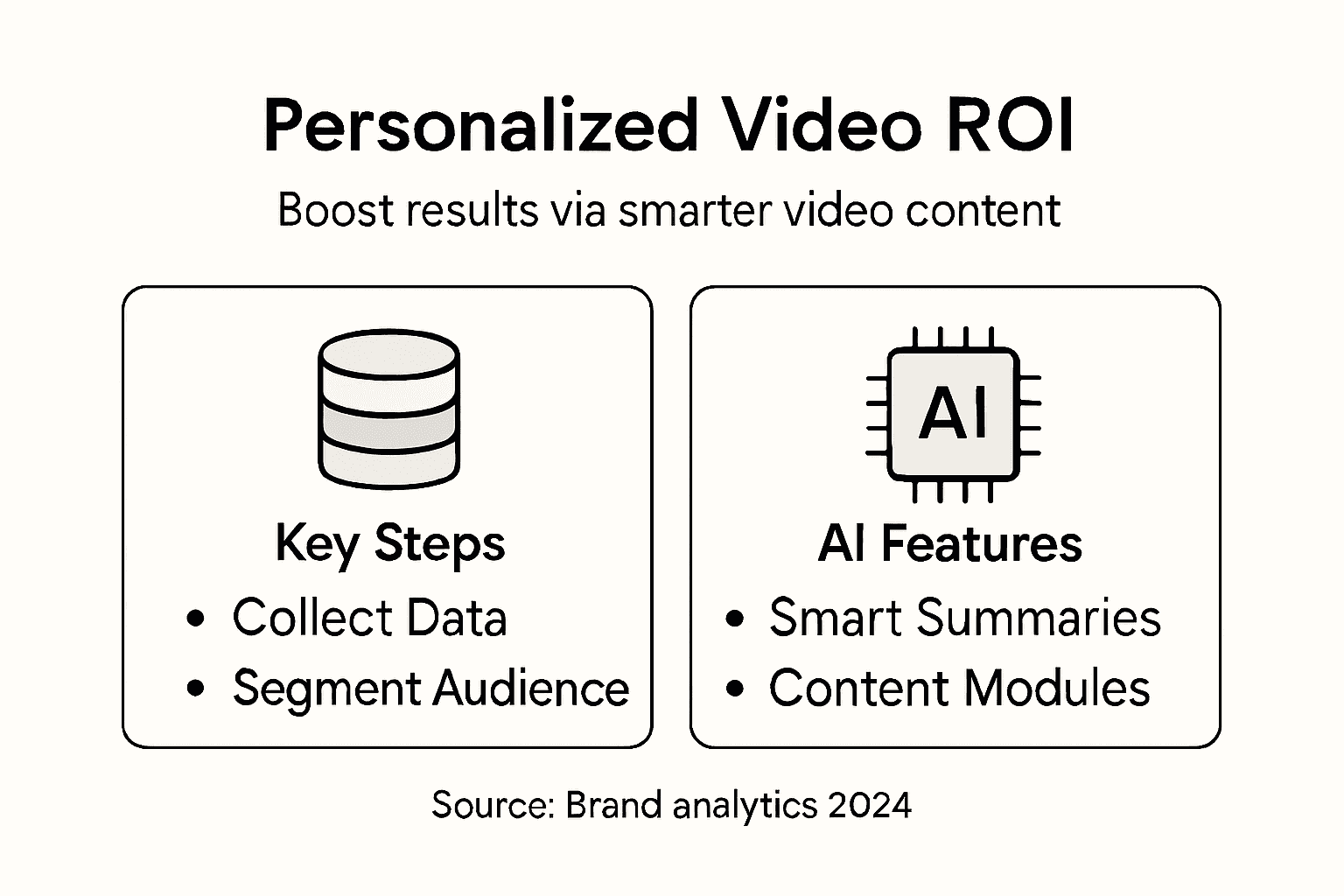
The workflow for creating personalized video content involves a multi-stage process that transforms raw data into precisely targeted visual narratives. Multimodal video analysis enables platforms to understand semantic context, filter relevant content, and apply user-specific preferences with remarkable precision. This approach allows for scalable processing across diverse video types and user segments.
When selecting a personalized video platform, brands should consider key evaluation criteria such as:
Consider these factors when choosing a personalized video platform:
| Platform Factor | Why It Matters | Typical Business Impact |
|---|---|---|
| Scalability | Supports audience growth | Handles more users and data |
| Integration Capabilities | Links with marketing tools | Streamlined workflows |
| Privacy Protections | Ensures compliance | Builds user trust |
| Algorithm Complexity | Enables fine personalization | Increases relevance |
| Cost Efficiency | Keeps expenses reasonable | Maximizes ROI |
- Scalability of content processing
- Complexity of personalization algorithms
- Integration capabilities with existing marketing technologies
- Ethical data usage and privacy protections
- Cost-effectiveness and return on investment
Pro tip: Conduct a comprehensive pilot test with multiple personalization platforms, carefully measuring engagement metrics to identify the solution that delivers the most significant improvement in viewer interaction.
Risks, Costs, and Common Mistakes to Avoid
Implementing personalized video content involves navigating a complex landscape of technological, ethical, and financial challenges that can significantly impact a brand's marketing effectiveness and user trust. Understanding these potential pitfalls is crucial for developing a successful and responsible personalization strategy.
Privacy concerns emerge as a primary risk in personalized video technologies. Brands must carefully balance data collection with user consent, avoiding invasive practices that could erode customer confidence. The potential risks include:
- Algorithmic bias in content selection
- Excessive user data collection
- Potential manipulation of viewer experiences
- Transparency challenges in recommendation systems
- Potential privacy regulation violations
Comprehensive dataset selection becomes critical in mitigating these risks. The most common mistakes brands encounter involve neglecting the nuanced variability of user preferences, relying on insufficient or biased training data, and failing to develop robust evaluation metrics for personalization effectiveness.
Cost considerations extend beyond simple platform investments, encompassing ongoing expenses such as:
- Advanced AI infrastructure development
- Continuous algorithm refinement
- Data acquisition and management
- Compliance and privacy protection mechanisms
- Performance monitoring and optimization
Pro tip: Implement a rigorous quarterly review process that assesses your personalization strategy's privacy compliance, algorithmic fairness, and user engagement metrics to proactively identify and mitigate potential risks.
Elevate Your E-Commerce Strategy with Personalized Video Solutions
Unlock the true potential of personalized video content to maximize your e-commerce ROI by transforming complex AI-driven concepts into effortless creative workflows. This article highlights challenges such as adapting dynamic content selection, real-time personalization, and sophisticated segmentation to engage targeted audiences effectively. If you aim to overcome these barriers and enhance product showcases or targeted advertising with adaptive, cinematic videos, there is a simpler way.
At Palmedor.ai, we empower brands and creators to develop high-quality, personalized video content swiftly using AI-powered script generation and scene management. Our platform addresses key pain points like scalability, customization, and integration without demanding extensive technical skills or costly infrastructure. With features designed to handle everything from short social clips to full narrative films, you get professional-grade results that resonate with your customers.
Take control of your video marketing today and experience how AI transforms personalization into a powerful ROI driver.
Ready to simplify your personalized video creation while boosting engagement? Explore how AI-powered video production can revolutionize your e-commerce content strategy. Visit Palmedor.ai now to start turning your ideas into compelling, conversion-focused videos with ease.
Frequently Asked Questions
What is personalized video content in e-commerce?
Personalized video content in e-commerce refers to dynamic video experiences tailored to individual viewer preferences and behaviors, enhancing user engagement and interaction with products.
How does personalized video content improve conversion rates?
Personalized video content increases conversion rates by showcasing relevant products based on user browsing history and preferences, creating a more engaging and targeted shopping experience.
What technologies are utilized for creating personalized video content?
Technologies for creating personalized video content include AI-driven algorithms, deep learning models, and natural language processing, which analyze user data to generate tailored video segments.
What are the common mistakes brands make when implementing personalized video content?
Common mistakes include neglecting user privacy, failing to adapt to varying user preferences, and relying on insufficient or biased training data for content personalization.