Overcoming Creative Blocks: Unlock Your Creativity Now
Learn actionable strategies for overcoming creative blocks with this step-by-step guide to unleash your creativity and boost productivity.
Overcoming Creative Blocks: Unlock Your Creativity Now
Creative blocks have stopped even the best ideas in their tracks and nearly everyone hits a wall at some point. But studies show that just identifying your unique creative obstacles can open the door to fresh breakthroughs. Most people think inspiration is just about waiting it out or forcing new ideas but the real secret comes down to a few practical steps that surprise most creators.
Table of Contents
- Step 1: Identify Your Creative Blocks
- Step 2: Create a Stimulation Environment
- Step 3: Engage in Creative Exercises
- Step 4: Collaborate with Others
- Step 5: Implement a Reflection Process
Quick Summary
| Key Point | Explanation |
|---|---|
| 1. Identify your creative blocks | Understand specific obstacles that hinder creativity to effectively address and overcome them. |
| 2. Create a stimulating environment | Design your workspace to enhance inspiration, focusing on sensory elements that support creativity. |
| 3. Engage in creative exercises | Regularly practice creativity techniques to develop flexible thinking and foster innovation. |
| 4. Collaborate with diverse partners | Work with others to gain new perspectives and foster collective creativity beyond individual limitations. |
| 5. Implement a structured reflection process | Reflect on your creative experiences to consolidate learning and improve future creative endeavors. |
Step 1: Identify Your Creative Blocks
Understanding and overcoming creative blocks begins with honest self-reflection. These invisible barriers can paralyze even the most talented creators, preventing innovative ideas from emerging. Identifying your specific creative obstacles is the crucial first step in breaking through mental limitations and rediscovering your creative potential.
Recognizing Personal Creative Barriers
Creative blocks manifest differently for each individual. Some professionals experience mental paralysis when facing a blank canvas or empty document, while others struggle with persistent self-doubt or perfectionist tendencies. According to the American Psychological Association, these blocks often stem from complex psychological factors that extend beyond simple lack of inspiration.
Start by conducting a personal audit of your creative process. Ask yourself targeted questions about your work patterns, emotional responses, and recurring thoughts during creative tasks. What specific moments trigger your anxiety? When do you feel most stuck? Are there particular projects or types of assignments that consistently challenge your creative flow?
Documenting these insights provides a roadmap for understanding your unique creative obstacles. Consider maintaining a creativity journal where you track your mental states, productivity levels, and emotional responses during different creative endeavors. This practice helps identify patterns and potential triggers that interrupt your creative momentum.
Practical Self-Assessment Techniques
To systematically identify your creative blocks, implement a structured self-assessment approach. Observe your behavior during creative tasks and look for common disruption points. Some individuals discover their blocks emerge from:
- Fear of imperfect outcomes
- Overwhelming project complexity
- Lack of clear starting point
- Internal negative self-talk
- Performance anxiety
- External distractions
Each identified block represents an opportunity for strategic intervention.
Below is a summary table organizing the main creative self-assessment techniques and associated triggers to help you quickly identify areas for focused improvement.
| Technique | Focus Area | Common Triggers Identified |
|---|---|---|
| Personal audit of creative process | Work patterns, emotional responses | Anxiety at specific moments, recurring self-doubt |
| Creativity journal documentation | Mental states, productivity patterns | Stuck during certain projects, negative self-talk |
| Observing disruption points | Behavioral cues during tasks | Overwhelming complexity, unclear starting point |
| Structured self-questioning | Thought patterns during creative work | Fear of imperfection, performance anxiety |
| Environmental audit | Workspace influences | External distractions |
| By understanding the root causes of your creative resistance, you can develop targeted strategies to circumvent these mental barriers. |
 Remember, recognizing the problem is the first step toward meaningful transformation in your creative process.
Successful identification of creative blocks requires patience, honesty, and a willingness to examine your inner creative landscape without judgment. Your goal is not immediate perfection but gradual, sustainable improvement in navigating creative challenges.
Step 2: Create a Stimulation Environment
Transforming your physical and mental workspace is a powerful strategy for overcoming creative blocks. A purposefully designed environment can dramatically enhance your creative potential by reducing mental friction and increasing inspirational triggers. This step focuses on crafting a stimulation environment that naturally supports and nurtures your creative workflow.
Stanford researchers have demonstrated that creativity flourishes in spaces designed to inspire exploration and innovation. Your environment is more than just a physical location it is a psychological catalyst that can either inhibit or amplify your creative output.
Begin by auditing your current workspace. Look beyond mere aesthetics and examine how your environment impacts your mental state. Consider the lighting, color schemes, noise levels, and overall sensory experience. Natural light plays a crucial role in maintaining energy and focus. Position your workspace near windows or invest in full-spectrum lighting that mimics daylight. These subtle environmental adjustments can significantly improve mood and cognitive performance.
Next, curate your workspace with intentional elements that spark creativity. This might include artwork that resonates with your creative goals, books that inspire your work, or objects that hold personal significance. Create a visual landscape that tells a story and stimulates your imagination. Some creators find inspiration in mood boards that capture their aspirational creative vision, while others prefer minimalist spaces that reduce cognitive overload.
Sound management is another critical aspect of your stimulation environment. Some individuals thrive in complete silence, while others require background noise to maintain focus. Experiment with different soundscapes:
- Instrumental music without lyrics
- Nature sounds like rainfall or ocean waves
- Ambient electronic tracks
- White noise or noise-canceling technologies
- Low-volume background podcasts
Technology can be both a blessing and a distraction in your creative environment. Establish clear boundaries with digital devices to maintain focus. Consider using apps that block notifications during dedicated creative sessions or creating physical separation between your work area and communication devices.
Verify the effectiveness of your stimulation environment by tracking your creative output. Notice improvements in idea generation, project completion rates, and overall creative satisfaction. A truly stimulating environment should feel effortless, almost magnetic, drawing you into a state of focused creativity with minimal resistance.
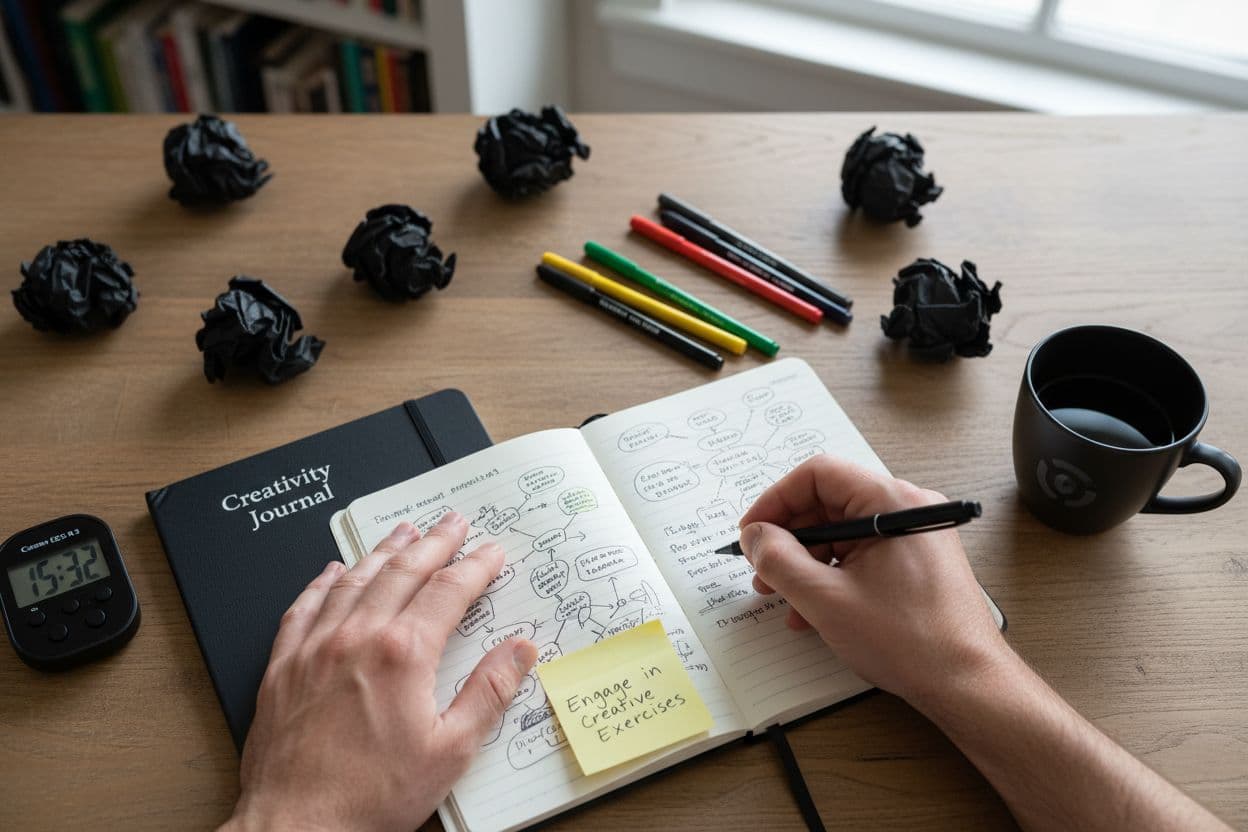
Step 3: Engage in Creative Exercises
Creative exercises are the gymnasium for your imagination, providing structured opportunities to stretch mental muscles and break through persistent creative blocks. Deliberate practice of targeted creativity techniques can rewire your cognitive pathways, transforming how you generate and develop innovative ideas.
Empirical research demonstrates that consistent engagement with divergent thinking exercises significantly enhances creative potential. These exercises are not about producing perfect work but about training your mind to approach challenges with flexibility and novel perspectives.
Start by implementing daily creative warm-up rituals that challenge your conventional thinking patterns. Morning pages offer an excellent initial exercise where you write three consecutive pages of unfiltered, stream-of-consciousness content. This practice helps clear mental clutter and surfaces underlying creative impulses that often remain suppressed during structured work.
Expand your creative repertoire through intentional constraint-based challenges. Limitations paradoxically unleash creativity by forcing your brain to navigate unconventional problem-solving routes. For instance, challenge yourself to describe a complex concept using only single-syllable words, or create a narrative using exactly 50 words. These micro-challenges compel your mind to think beyond default cognitive patterns.
Cross-disciplinary exploration serves as another powerful creative stimulation technique. If you work in visual media, experiment with writing poetry. If you are a writer, try sketch drawing. These seemingly unrelated activities create neural connections that spark unexpected insights and innovative thinking approaches.
Develop a consistent creative exercise routine with these potential activities:
- Random word association challenges
- Rapid sketching or quick design sprints
- Improvisational storytelling
- Mind mapping without predetermined outcomes
- Deliberately reframing problem statements
- Reverse engineering existing creative works
Document your creative exercise journey. Maintain a creativity log tracking your experiments, insights, and breakthrough moments. This practice helps you recognize patterns in your creative process and provides motivation by visualizing your progressive skill development.
Verify your creative exercise effectiveness by monitoring three key indicators: increased idea generation speed, greater comfort with uncertainty, and a more playful approach to problem-solving.
Here is a checklist table to help you verify the effectiveness of your creative exercises based on key indicators mentioned in the article.
| Checklist Item | Why It Matters | How to Track |
|---|---|---|
| Increased idea generation speed | Measures creative flexibility and output | Note how quickly you develop new ideas over a period |
| Greater comfort with uncertainty | Indicates adaptability in challenging tasks | Reflect on your feelings during uncertain or ambiguous exercises |
| More playful problem-solving | Shows progress in overcoming rigid thinking | Record instances where you experimented with unusual approaches |
| Consistent creative routine | Builds creative momentum over time | Keep a log of daily creative exercises completed |
| Documented insights and breakthroughs | Highlights tangible growth in your process | Record insights in a creativity log after each session |
| Remember, creativity is a skill that improves with intentional, consistent practice. Embrace the process, celebrate small victories, and remain patient with your creative growth. |
Step 4: Collaborate with Others
Collaboration transforms individual creative potential into collective innovation. Breaking through creative blocks often requires stepping outside your solitary workspace and engaging with diverse perspectives. By intentionally seeking collaborative opportunities, you can unlock new dimensions of creative thinking that would remain inaccessible when working alone.
Research published in Frontiers in Psychology demonstrates that group ideation sessions activate collective intelligence, generating novel associations and breakthrough ideas. This step is about strategically expanding your creative ecosystem beyond personal limitations.
Begin by identifying potential collaboration partners who bring complementary skills and different cognitive approaches. Look beyond your immediate professional circle. Artists might find inspiration collaborating with engineers, writers could partner with visual designers, and filmmakers could engage with musicians. The goal is to create friction between different thinking styles that sparks unexpected creative solutions.
Establish structured collaboration frameworks that respect individual creativity while promoting collective exploration. This might involve setting clear ground rules that encourage open dialogue, suspend immediate judgment, and value each participant's unique contribution. Create safe spaces where wild ideas can emerge without fear of immediate criticism. The most innovative solutions often start as seemingly ridiculous concepts that evolve through collective refinement.
Technology offers unprecedented collaboration opportunities. Virtual platforms enable creative exchanges across geographical boundaries. Use tools that facilitate seamless idea sharing:
- Cloud-based collaborative documents
- Digital whiteboarding platforms
- Real-time communication applications
- Project management tools with visualization features
- Creative community forums
Develop a collaborative mindset that views feedback as a gift rather than criticism. Practice active listening during group sessions, asking clarifying questions that help you understand different perspectives. Your role is to absorb insights, not defend your original concept. The most powerful collaborative moments happen when you remain genuinely curious about alternative viewpoints.
Verify the effectiveness of your collaborative approach by tracking tangible outcomes. Look for indicators such as increased idea generation velocity, emergence of solutions you would never have conceived independently, and personal growth in adaptability. Successful collaboration is not about achieving unanimous agreement but about creating a dynamic environment where creative potential can flourish collectively.
Step 5: Implement a Reflection Process
Reflection transforms creative experiences from isolated events into powerful learning opportunities. A structured reflection process acts as your personal creative GPS, helping you navigate future challenges with greater insight and strategic awareness. This critical step moves beyond simply completing projects to understanding the deeper mechanics of your creative journey.
Recent research confirms that systematic reflection following creative tasks helps individuals consolidate learning and recognize successful strategies. By developing an intentional reflection framework, you create a continuous improvement loop for your creative practice.
Begin by establishing a consistent reflection ritual immediately after completing a creative project or experiencing a significant creative moment. Choose a medium that feels most natural to you writing, audio recording, video journal, or digital documentation. The key is capturing your raw, unfiltered observations while insights are still fresh and vibrant.
Design your reflection process around strategic questioning. Move beyond surface level assessments and dive into deeper analytical exploration. Investigate not just what happened, but why it happened. Ask yourself penetrating questions that expose underlying creative dynamics. What emotional states preceded your most productive moments? Which environmental factors enhanced or hindered your creative flow? Where did you experience resistance, and what triggered those blockages?
Develop a comprehensive reflection framework that addresses multiple dimensions of your creative experience:
- Emotional landscape during the creative process
- Technical challenges encountered
- Unexpected insights or breakthroughs
- Personal growth observations
- Potential improvements for future projects
- Specific strategies that worked effectively
Utilize technology to enhance your reflection practice. Digital tools like journaling apps, voice recording platforms, and mind mapping software can help you capture and analyze your creative experiences more systematically. Create a personal knowledge base that tracks your creative evolution, allowing you to recognize patterns and track your progressive development over time.
Verify the effectiveness of your reflection process by monitoring tangible improvements in your creative workflow. Look for indicators such as faster problem solving, increased creative confidence, more nuanced understanding of your personal creative triggers, and a more adaptive approach to potential blocks. Remember that reflection is not about judgment but about curious, compassionate self-observation. Each reflection is an opportunity to understand yourself more deeply and refine your creative practice with greater intentionality.
Move from Blocked to Brilliant: Ignite Creativity with AI Video Tools
Struggling to break through creative barriers and finally bring your ideas to life? Many creators face mental roadblocks like fear of imperfection, self-doubt, or overwhelming complexity—all highlighted in our guide on overcoming creative blocks. Imagine channeling your fresh inspiration into visual storytelling, without technical frustration or production delays. Palmedor.ai makes this possible for everyone, no matter your video experience.

Why wait for a breakthrough when you can use Palmedor.ai right now? Discover how our AI-powered platform transforms your story concepts and reference images into cinematic videos within minutes. Whether you want to create brand films, social media clips, or personal narratives, our platform removes technical obstacles through script generation, scene management, and smart output customization. Keep building on your creative momentum by exploring examples, helpful guides, and flexible plans directly on the main website. Take the next step toward effortless video creation—visit Palmedor.ai today and watch your creative vision take shape immediately.
Frequently Asked Questions
How can I identify my personal creative blocks?
Recognizing your creative blocks involves honest self-reflection on your emotional responses and work patterns. Conduct a personal audit by asking targeted questions about moments when you feel stuck or anxious, and document your insights in a creativity journal to track patterns.
What practical changes can I make to my workspace to boost creativity?
Enhance your workspace by incorporating natural light, intentional decor, and sound management that caters to your preferences. Aim to create an environment that inspires you—like adding artwork or a mood board—within the next few days to see how it affects your creative flow.
What types of creative exercises can help me overcome blocks?
Engage in daily creative exercises like morning pages or constraint-based challenges that push you to think outside the box. Start with a warm-up ritual each morning, dedicating 10-15 minutes to free writing or short creative tasks, and notice improvements in your idea generation.
How can I effectively collaborate with others to boost my creativity?
Seek collaboration opportunities with individuals who have different perspectives or skills, and create a safe environment for open dialogue. Establish ground rules for collaborative sessions and prioritize active listening to generate new ideas moving forward.
Why is reflection important after completing a creative project?
Implementing a reflection process allows you to analyze what strategies worked and identify areas for improvement in your creative workflow. Dedicate time immediately after completing a project to jot down your experiences and insights, helping you refine your approach for future creative endeavors.
How long should I expect to see improvements in my creativity?
Expect to see improvements in your creative process within 30-60 days of implementing these strategies. Track specific indicators like increased idea generation and improved comfort with uncertainty to measure your progress.