Understanding How to Capture Audience Attention
Learn how to capture audience attention effectively through comprehensive understanding and clear explanations of key concepts.
Understanding How to Capture Audience Attention

Every day, people are flooded with messages, videos, and updates fighting for their simple glance. Turns out, if your content does not grab attention in the first few seconds, it risks getting lost forever. Most folks think getting attention is just about clever headlines or eye-catching visuals. But neuroscience says attention is a psychological process that decides whether your message even has a shot at making an impact.
Table of Contents
- What Is Audience Attention And Its Importance?
- Why Capturing Audience Attention Matters In Content Creation
- How Audience Attention Works: Psychological Insights
- Key Strategies For Engaging Your Audience Deeply
- Real-World Examples Of Successful Audience Engagement
Quick Summary
| Takeaway | Explanation |
|---|---|
| Engage through emotional relevance | Create content that resonates with audience sentiments to capture their attention. |
| Prioritize clear communication | Messages must be direct and understandable to prevent audience disengagement. |
| Utilize interactive techniques | Strategies that invite audience participation enhance connection and retention. |
| Adapt to audience preferences | Tailor your content delivery methods based on the audience's needs and expectations. |
| Use novelty to attract attention | Incorporating surprising elements can help break through digital noise and engage viewers effectively. |
What is Audience Attention and Its Importance?
Audience attention represents the psychological and cognitive engagement individuals demonstrate toward specific content, message, or communication. Understanding how to capture audience attention is critical in an increasingly competitive information landscape where individuals are constantly bombarded with competing stimuli.
The Psychological Foundation of Audience Attention
At its core, audience attention is a complex cognitive process involving selective perception and mental focus. When content successfully captures attention, it triggers neurological responses that transform passive viewing into active engagement. According to Newcastle University, audiences are not inherently obligated to provide their attention, making it essential to create compelling, relevant content that resonates with their interests and needs.
Key elements that influence audience attention include:
- Emotional relevance
- Novelty and surprise
- Personal connection
- Clear communication
- Visual and auditory stimulation
Significance in Communication and Engagement
Audience attention serves as a critical gateway for effective communication. Without sustained attention, messages become background noise, failing to achieve their intended purpose. Whether in marketing, education, entertainment, or professional presentations, capturing and maintaining audience attention determines the success of communication strategies.
The ability to understand and strategically engage audience attention allows creators to:
- Communicate ideas more effectively
- Create memorable experiences
- Drive desired actions or responses
- Build stronger connections with target audiences
Successful audience engagement requires a nuanced understanding of human cognitive processes, psychological triggers, and communication dynamics. By recognizing attention as an active, dynamic process rather than a passive state, communicators can develop more sophisticated and impactful strategies for connecting with their intended audience.
Why Capturing Audience Attention Matters in Content Creation
In an era of unprecedented digital noise and information overload, capturing audience attention has become a critical challenge for content creators across multiple domains. The ability to engage viewers quickly and meaningfully can determine the success or failure of communication strategies.
The Competitive Landscape of Audience Engagement
Modern audiences are continuously bombarded with content from numerous channels, making their attention a precious and limited resource. According to Frontiers in Human Neuroscience, attention is a finite cognitive resource that directly influences learning, memory, and behavioral responses. This means content creators must strategically design their material to cut through the overwhelming digital clutter.
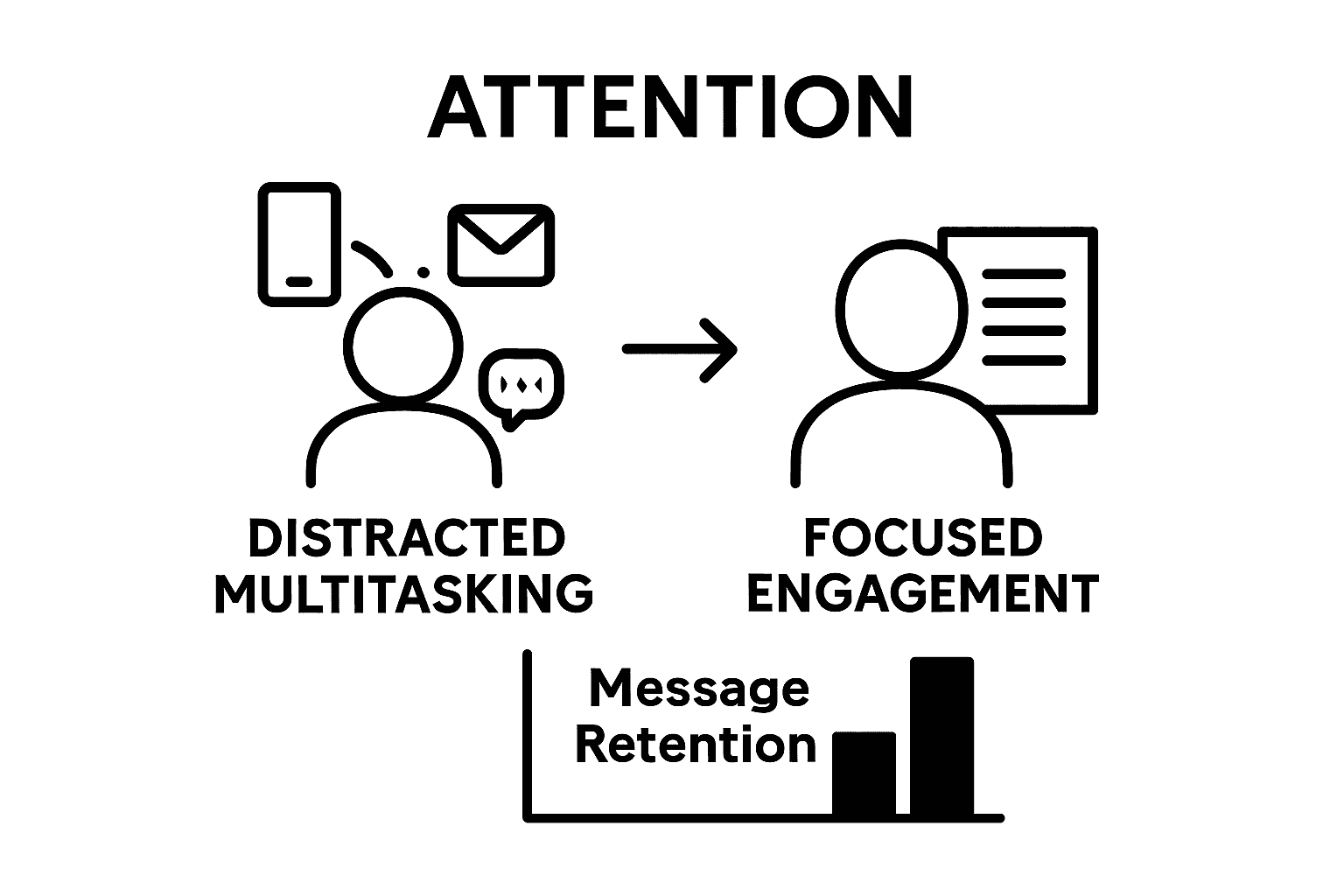
Key challenges in capturing audience attention include:
- Extremely short attention spans
- Constant digital distractions
- High competition for viewer engagement
- Rapidly changing content consumption patterns
- Increasing sophistication of audience expectations
Strategic Implications for Content Performance
Capturing audience attention is not merely about initial engagement but about creating sustained interest that drives meaningful interactions. When content successfully captures attention, it can:
- Increase message retention and comprehension
- Improve conversion rates
- Enhance brand recognition
- Generate emotional connections
- Encourage further exploration of the content
The stakes are high in content creation: messages that fail to capture attention within the first few seconds risk being completely overlooked. This makes understanding audience psychology and crafting compelling, targeted content more crucial than ever. Successful content creators must continually adapt their strategies, understanding that audience attention is earned, not assumed.
The following table organizes common challenges faced in capturing audience attention alongside strategic implications and possible outcomes for content performance, helping readers connect tactics to real-world results.
| Challenge | Strategic Implication | Potential Positive Outcome |
|---|---|---|
| Extremely short attention spans | Optimize content for immediate impact | Faster engagement, higher retention |
| Constant digital distractions | Use highly focused, relevant messaging | Decreased risk of audience drop-off |
| High competition for engagement | Differentiate with unique content elements | Stronger brand distinction |
| Rapidly changing consumption patterns | Adapt format and platform strategy | Content remains timely and accessible |
| Rising audience expectations | Increase content quality and personalization | Improved reputation and audience loyalty |
How Audience Attention Works: Psychological Insights
Audience attention functions as a complex neurological and psychological mechanism that determines how individuals process, engage with, and respond to information. Understanding the intricate dynamics of attention helps content creators develop more effective communication strategies.
Cognitive Processing and Selective Attention
The human brain operates with remarkable selectivity, filtering vast amounts of sensory information to focus on what it perceives as most relevant. According to PNAS research, psychological targeting reveals that individuals are more likely to engage with content that aligns with their specific psychological traits and personal interests.
Key factors influencing cognitive attention include:
- Personal relevance
- Emotional resonance
- Novelty and unexpectedness
- Perceived potential reward
- Individual cognitive processing speed
Neurological Mechanisms of Engagement
Attention is not a passive process but an active, dynamic interaction between external stimuli and internal cognitive states. The brain constantly evaluates incoming information through multiple neural networks, determining what deserves focused processing and what can be ignored.
Critical neurological aspects of attention involve:
- Rapid threat and opportunity assessment
- Pattern recognition
- Emotional and memory integration
- Predictive processing
- Cognitive resource allocation
The brain's attention mechanism operates like a sophisticated filter, prioritizing information that promises survival advantages, emotional satisfaction, or cognitive reward. This evolutionary adaptation ensures that individuals can navigate complex environments efficiently, focusing energy on what matters most in any given moment. Content creators who understand these psychological insights can design more compelling, resonant communication strategies that naturally attract and sustain audience engagement.
To clearly distinguish the main psychological and neurological factors that affect audience attention, the following table summarizes each key factor and its particular influence on engagement.
| Factor | Psychological Role | Influence on Engagement |
|---|---|---|
| Personal relevance | Aligns content with individual interests | Increases likelihood of focused attention |
| Emotional resonance | Triggers emotional response | Encourages deeper cognitive processing |
| Novelty and unexpectedness | Provides surprise or newness | Breaks habitual scanning, grabbing attention |
| Perceived potential reward | Signals tangible or intangible benefit | Sustains interest and reinforces engagement |
| Individual cognitive speed | Matches information flow to mental processing | Reduces disengagement due to overload |
| Visual and auditory stimulation | Engages senses directly | Enhances memorability and initial attraction |
| Pattern recognition | Enables the brain to find meaning quickly | Speeds up connection with the message |
Key Strategies for Engaging Your Audience Deeply
Audience engagement transcends mere passive observation, requiring intentional and strategic approaches that transform viewers from spectators into active participants. Creating profound connections demands more than superficial content delivery.
Psychological Connection and Relevance
Effective audience engagement begins with understanding and addressing the audience's core psychological needs and interests. According to Argonne National Laboratory, content creators must carefully tailor their communication by adjusting opening statements, word choice, visual presentations, and emphasis techniques to align with audience expectations.
Core psychological engagement principles include:
- Creating immediate emotional resonance
- Demonstrating genuine understanding
- Presenting relatable narratives
- Addressing underlying audience motivations
- Providing perceived value
Techniques for Deepening Audience Interaction
Transformative engagement requires moving beyond traditional one-way communication models. Interactive strategies that encourage active participation can dramatically enhance audience connection and content retention. This involves designing experiences that invite audience members to become co-creators of the communication journey.
Strategic interaction techniques involve:
- Incorporating interactive storytelling
- Using provocative questions
- Encouraging personal reflection
- Enabling real-time feedback mechanisms
- Creating participatory content experiences
Successful audience engagement is an intricate dance between understanding human psychology, crafting compelling narratives, and providing opportunities for meaningful interaction. By recognizing audiences as active participants rather than passive recipients, content creators can develop more nuanced, impactful communication strategies that resonate on deeper emotional and intellectual levels.

Real-World Examples of Successful Audience Engagement
Effective audience engagement transforms theoretical concepts into tangible, measurable outcomes across diverse industries and communication platforms. Analyzing successful real-world strategies provides invaluable insights into the practical application of audience connection techniques.
Cultural and Institutional Engagement Strategies
Museums and cultural institutions have pioneered innovative approaches to audience engagement that extend far beyond traditional communication models. According to the Natural History Museum of Los Angeles County, user-generated content campaigns can dramatically enhance audience participation and institutional visibility.
Key characteristics of successful institutional engagement include:
- Empowering audience members as content creators
- Developing interactive, participatory experiences
- Recognizing and celebrating community contributions
- Creating platforms for meaningful dialogue
- Adapting communication strategies to audience preferences
Cross-Platform Engagement Techniques
Modern audience engagement requires a sophisticated, multi-dimensional approach that integrates digital and physical interaction spaces. Successful strategies leverage technology, storytelling, and personalized experiences to create deeper, more meaningful connections.
Critical engagement techniques across platforms involve:
- Utilizing social media for real-time interaction
- Developing immersive, interactive content experiences
- Creating personalized communication pathways
- Implementing responsive feedback mechanisms
- Designing experiences that transcend traditional media boundaries
Successful audience engagement is not about manipulating attention but creating genuine, value-driven connections that respect audience intelligence and agency. By understanding the complex dynamics of human interaction and leveraging innovative communication technologies, organizations can develop engagement strategies that are both authentic and transformative.
Ready to Capture Real Audience Attention? Transform Ideas Into Cinematic Videos Instantly
You just learned how powerful audience attention is and why real engagement is essential in a crowded digital world. If you are frustrated with content that fails to spark interest or deliver emotional impact, the solution may be simpler than you think. With so much competition for every second of attention, you need tools designed to help create meaningful, memorable connections—without extra time or technical stress.

Imagine building cinematic videos from just your ideas and images, letting artificial intelligence handle everything from scene design to script and edit. Palmedor.ai empowers you to capture attention quickly using fast, intuitive video creation powered by advanced AI. Try creating a social clip or a compelling brand story today and see how easy it is to get results that turn viewers into fans. Visit the main website to explore examples, FAQs, and flexible plans. Do not let your story get lost—take action now and experience a smarter way to engage your audience.
Frequently Asked Questions
What is audience attention, and why is it important for communication?
Audience attention is the psychological and cognitive engagement individuals have towards specific content. It's crucial for effective communication because it ensures messages are not overlooked and can help achieve the intended purpose across various domains such as marketing, education, and entertainment.
How does understanding audience psychology help in capturing attention?
Understanding audience psychology allows content creators to tailor their strategies to align with the audience's interests and emotional triggers, making it easier to capture and maintain their attention effectively.
What are some key factors that influence audience attention?
Key factors include emotional relevance, novelty, personal connection, clear communication, and visual or auditory stimulation. These elements can significantly enhance engagement and retention.
What strategies can be used to engage an audience more deeply?
Strategies for deeper engagement include creating emotional resonance, using interactive storytelling, asking provocative questions, encouraging personal reflection, and facilitating real-time feedback mechanisms.