Creative Agency Video Production: Leveraging AI Innovation
Creative agency video production with AI: discover workflow automation, smart tools, real-world uses, costs, and comparison to traditional methods.
Creative Agency Video Production: Leveraging AI Innovation

Nearly 85 percent of American creative agencies say that video outperforms every other content type for capturing attention on social media. In a world where visual stories shape brand identity in seconds, the pressure to deliver engaging narratives faster than ever is universal. This guide dives into how AI-driven video production empowers creative teams to stand out, meet rising expectations, and transform abstract ideas into impactful audience connections.
Table of Contents
- Defining Creative Agency Video Production Today
- Types of Video Services and Deliverables
- How AI Is Reshaping Video Workflows
- Advantages for Agencies and Brand Storytelling
- Costs, Limitations, and Choosing Tools
- Comparing AI Vs. Traditional Production Approaches
Key Takeaways
| Point | Details |
|---|---|
| Integration of AI | AI technologies are transforming video production, enhancing automation and efficiency while augmenting human creativity. |
| Strategic Storytelling | Agencies must focus on narrative experiences that resonate emotionally with audiences and align with branding objectives. |
| Continuous Learning | Investing in technological upskilling ensures agencies remain competitive in the rapidly evolving video production landscape. |
| Hybrid Approaches | The future lies in combining human creativity with AI capabilities, enabling more dynamic and personalized content creation. |
Defining Creative Agency Video Production Today
Creative agency video production represents a sophisticated intersection of storytelling, technology, and strategic communication. Modern creative agencies have transformed from traditional production services into dynamic strategic partners capable of crafting compelling visual narratives that drive brand engagement and marketing objectives.
Today's video production landscape requires agencies to balance artistic creativity with technological precision. Video production professionals must navigate an increasingly complex ecosystem that demands rapid adaptation to emerging technologies, changing audience preferences, and sophisticated communication strategies. This evolution means agencies now integrate data-driven insights, advanced software tools, and innovative techniques to deliver maximum impact for their clients.
Key characteristics of contemporary creative agency video production include:
- Comprehensive end-to-end content development
- Strategic alignment with brand identity and marketing goals
- Integration of artificial intelligence and machine learning technologies
- Multiplatform content optimization
- Advanced storytelling techniques leveraging behavioral psychology
The fundamental goal remains consistent: transforming abstract concepts into engaging visual experiences that connect emotionally with target audiences while delivering measurable business results. Success now hinges on an agency's ability to blend creative vision with technological innovation, creating content that resonates across digital platforms and captures audience attention in increasingly competitive media landscapes.
Pro tip: Invest in continuous learning and technological upskilling to stay ahead of emerging video production trends and maintain your creative agency's competitive edge.
Types of Video Services and Deliverables
Video production services represent a comprehensive ecosystem of creative solutions designed to transform complex business narratives into compelling visual stories. These services span three critical phases: pre-production, production, and post-production, each contributing unique value to the final deliverable. Pre-production involves strategic planning, including script development, talent casting, and location scouting, while production focuses on capturing high-quality footage, and post-production refines the raw materials into polished, impactful content.
Modern video production agencies offer a diverse range of specialized services tailored to meet specific business communication objectives. These typically include:
- Promotional Videos: Designed to showcase products, services, or brand positioning
- Corporate Communication Videos: Internal and external messaging for organizational storytelling
- Social Media Content: Short-form videos optimized for digital platforms
- Event Coverage: Documentarian and highlight reel productions
- Explainer Videos: Technical or educational content that breaks down complex concepts
- Live Streaming: Real-time event broadcasting and interactive digital experiences
The true value of video production services lies not just in technical execution but in strategic storytelling. Agencies must understand client brand identity, target audience psychology, and platform-specific engagement dynamics. This requires a nuanced approach that combines creative vision with data-driven insights, ensuring each video serves a precise marketing or communication purpose.
Successful video services go beyond mere visual production. They create narrative experiences that resonate emotionally, communicate complex ideas succinctly, and drive meaningful audience engagement across multiple digital ecosystems. The most effective agencies treat each project as a unique storytelling opportunity, meticulously crafting content that reflects brand personality while meeting specific communication objectives.
Pro tip: Develop a comprehensive creative brief that clearly articulates your brand's core message, target audience, and desired emotional response before beginning any video production project.
How AI Is Reshaping Video Workflows
Generative AI technologies are dramatically transforming video production workflows by introducing unprecedented levels of automation, creativity, and efficiency. These advanced systems are capable of generating complex visual content, synthesizing images and video, creating consistent character representations, and streamlining traditionally labor-intensive production processes. The technological revolution goes beyond simple automation, fundamentally reimagining how creative professionals conceptualize, develop, and execute visual storytelling.
AI integration in video production encompasses multiple critical workflow dimensions:
- Script Generation: AI-powered writing assistants that draft initial narrative structures
- Visual Effects Creation: Automated generation of complex visual elements
- Character Design: Rapid avatar and character development
- Editing Automation: Intelligent content arrangement and sequence optimization
- Motion Graphics: Procedural animation and design generation
- Color Grading: Automated color correction and stylistic consistency
While AI technologies offer remarkable capabilities, they are not replacing human creativity but augmenting it. Creative professionals now function more as strategic directors and curators, guiding AI tools to realize their artistic vision. This collaborative approach allows for more experimental, nuanced storytelling approaches that were previously constrained by technical limitations or production costs.

The emerging AI-enhanced video workflow represents a profound paradigm shift. By reducing technical barriers and mundane production tasks, these technologies enable creators to focus more on conceptual innovation, emotional storytelling, and pushing creative boundaries. The most successful video production teams will be those who learn to effectively integrate AI as a powerful collaborative tool, maintaining human creativity and emotional intelligence at the core of their storytelling process.
Here’s a summary of the unique business benefits gained by integrating AI into creative video production:
| Benefit Category | AI-Driven Enhancement | Business Impact |
|---|---|---|
| Content Personalization | Dynamic adaptation to viewer data | Higher audience engagement |
| Production Efficiency | Automated editing and graphics | Lower costs and faster turnaround |
| Creative Scalability | Rapid format and style variations | Multi-platform reach and brand cohesion |
| Data Insights | Real-time performance analytics | Informed strategy and improved ROI |
Pro tip: Invest time in understanding AI video production tools and develop a workflow that strategically combines human creative direction with AI-powered efficiency.
Advantages for Agencies and Brand Storytelling
Generative AI technologies are revolutionizing brand storytelling by offering unprecedented capabilities for personalization, efficiency, and creative innovation. These advanced systems enable agencies to craft narratives that are not just visually compelling but strategically tailored to specific audience segments, leveraging deep insights into consumer behavior and preferences. The result is a more nuanced, responsive approach to brand communication that transcends traditional marketing methodologies.
AI-powered brand management tools provide agencies with multiple strategic advantages:
- Rapid Content Generation: Accelerated creation of diverse marketing materials
- Hyper-Personalization: Customized storytelling based on granular audience data
- Emotional Intelligence: Enhanced narrative resonance through sentiment analysis
- Cost Efficiency: Reduced production time and operational expenses
- Consistent Brand Voice: Maintaining stylistic coherence across multiple channels
- Real-Time Adaptation: Dynamic content adjustment based on audience engagement
The transformative potential of AI extends beyond mere automation. Creative agencies can now function as strategic storytellers, using intelligent technologies to amplify human creativity rather than replace it. By integrating AI tools, teams can shift from repetitive technical tasks to high-value creative direction, focusing on emotional depth, strategic positioning, and innovative storytelling approaches that truly connect with audiences.
Ultimately, the most successful agencies will be those who view AI not as a replacement for human creativity, but as a powerful collaborative tool. These technologies offer unprecedented opportunities to craft more sophisticated, data-informed, and emotionally resonant brand narratives that can adapt in real-time to changing consumer landscapes and emerging market dynamics.
Pro tip: Develop a comprehensive AI integration strategy that balances technological capabilities with your agency's unique creative vision and brand expertise.
Costs, Limitations, and Choosing Tools
AI video production technologies represent a complex landscape of opportunities and challenges, requiring strategic evaluation beyond surface-level capabilities. While these innovative tools promise unprecedented efficiency, they simultaneously introduce nuanced constraints that demand careful navigation by creative professionals. Understanding the intricate balance between technological potential and practical limitations becomes crucial for agencies seeking to integrate AI effectively into their workflows.
Key considerations when evaluating AI video production tools include:
- Cost Structures: Subscription models, per-project pricing, and scalability
- Performance Consistency: Quality and reliability of generated content
- Creative Limitations: Depth of artistic interpretation and emotional nuance
- Technical Integration: Compatibility with existing production ecosystems
- Ethical Considerations: Copyright and data usage protocols
- Customization Capabilities: Flexibility in adapting to specific brand requirements
The most successful implementation strategies recognize AI as a collaborative tool rather than a complete replacement for human creativity. Agencies must develop sophisticated evaluation frameworks that assess not just technological capabilities, but also alignment with their unique creative vision. This approach involves rigorous testing, pilot programs, and continuous skill development to maximize the potential of AI-driven production technologies while maintaining artistic integrity and brand authenticity.
Ultimately, selecting the right AI video production tools requires a holistic approach that balances technological innovation with strategic creative objectives. Creative teams must remain adaptable, continuously learning and evolving their understanding of these emerging technologies. The goal is not wholesale replacement of human creativity, but rather strategic augmentation that empowers creators to push beyond traditional production limitations.
Pro tip: Implement a comprehensive evaluation framework that includes both technical performance metrics and creative alignment when assessing AI video production tools.
Comparing AI vs. Traditional Production Approaches
The emergence of artificial intelligence in video production represents a transformative shift from traditional creative workflows, challenging long-established methodologies and introducing unprecedented levels of efficiency and innovation. While traditional approaches rely heavily on human expertise, manual processes, and linear production cycles, AI-driven technologies offer a dynamic, adaptive framework that fundamentally reimagines content creation strategies.
Key comparative dimensions between AI and traditional video production include:
- Production Speed: AI dramatically accelerates content generation
- Cost Efficiency: Reduced labor hours and operational expenses
- Creative Flexibility: Instant iterations and experimental approaches
- Resource Requirements: Minimal human intervention for repetitive tasks
- Scalability: Rapid content adaptation across multiple formats
- Consistency: Standardized quality and stylistic coherence
Traditional production methods excel in nuanced emotional storytelling and complex creative decision-making, while AI technologies shine in automation, data-driven personalization, and rapid content generation. The most effective strategies will not view these approaches as competing paradigms, but as complementary systems where human creativity guides and refines AI-generated capabilities. Creative professionals become strategic directors, leveraging intelligent technologies to expand their creative potential rather than being constrained by traditional production limitations.
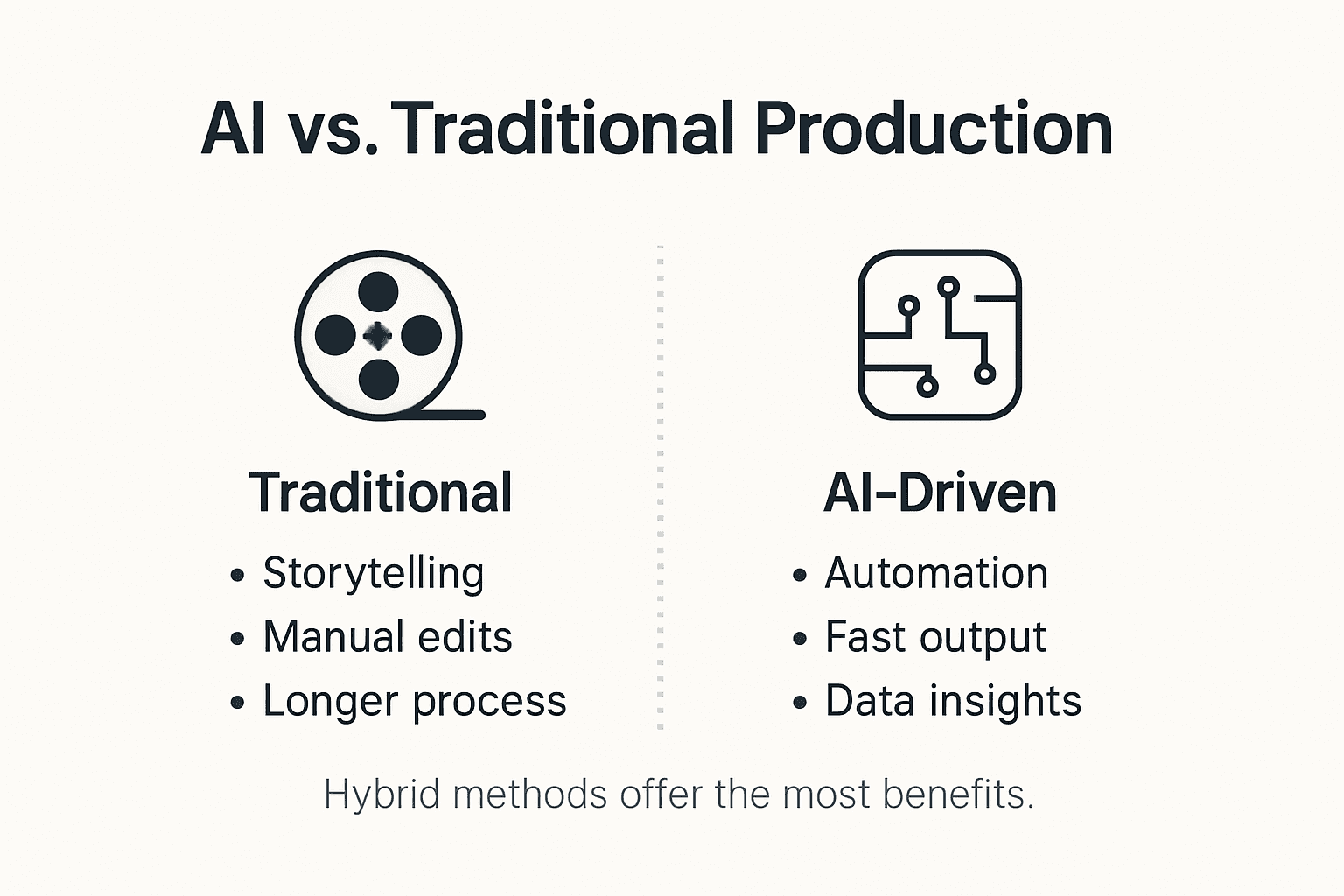
To clarify differences, here is a comparison of traditional versus AI-powered video production approaches:
| Dimension | Traditional Production | AI-Driven Production |
|---|---|---|
| Human Involvement | Manual, labor-intensive | Guided by creators, automated tasks |
| Speed | Slower, sequential | Rapid, parallel processing |
| Creative Exploration | Limited by time/cost | Instant variations, easy testing |
| Content Consistency | Relies on manual review | Algorithm-enforced uniformity |
The future of video production lies in a hybrid model that seamlessly integrates human intuition with artificial intelligence. Agencies and creators who develop sophisticated collaborative frameworks will be best positioned to harness the transformative potential of these emerging technologies, creating more dynamic, personalized, and engaging visual narratives that resonate across increasingly fragmented media landscapes.
Pro tip: Develop a balanced skill set that combines traditional creative expertise with technical proficiency in AI-powered production tools.
Elevate Your Creative Agency Video Production with AI-Powered Innovation
The article highlights the challenges creative agencies face today including balancing artistic vision with technological precision and integrating AI tools effectively to boost storytelling, speed, and brand engagement. If your goal is to overcome production inefficiencies and unlock scalable, data-driven creativity while preserving emotional resonance then advanced AI video creation is the key. Leveraging concepts like script generation, editing automation, and multiplatform optimization can transform abstract ideas into cinematic, emotionally engaging brand stories that capture audience attention.

Explore how Palmedor.ai empowers creative professionals by simplifying complex video workflows through an AI-powered platform designed for effortless script creation, scene management, and output customization. Whether you need promotional videos, social clips, or brand films, Palmedor.ai adapts to your unique vision without requiring extensive technical skills. Don’t let traditional production slow you down – start harnessing the future of video with AI-driven efficiency and creativity now. Discover more and begin your next project today at Palmedor.ai and experience a smarter way to produce professional-grade videos. Learn how to align your brand storytelling with strategic innovation with resources found at Creative Agency Insights and start creating videos that truly connect.
Frequently Asked Questions
What are the main phases of video production in a creative agency?
The main phases of video production include pre-production (planning, script development, talent casting, and location scouting), production (capturing high-quality footage), and post-production (editing and refining the content into a polished final product).
How is AI changing the video production workflow?
AI is transforming video production by introducing automation in script generation, visual effects creation, character design, and editing. These advancements allow creative professionals to focus more on strategic direction and less on repetitive tasks, enhancing overall efficiency and creativity.
What benefits does AI integration provide for brand storytelling?
AI integration allows for rapid content generation, hyper-personalization based on audience data, enhanced emotional resonance through sentiment analysis, and cost efficiency by reducing production time and expenses. This leads to more effective and engaging brand narratives.
How do AI video production tools compare to traditional production methods?
AI video production tools offer faster content generation, cost efficiency, and creative flexibility compared to traditional methods, which rely heavily on manual processes. However, traditional methods excel in nuanced emotional storytelling and complex decision-making, making a hybrid approach the most effective strategy.