Content Creation With AI: The Essential Guide
Content creation with AI explained: discover types, processes, top features, real-world use cases, costs, risks, and common pitfalls in this complete overview.
Content Creation With AI: The Essential Guide

Nearly 80 percent of marketers say they now use artificial intelligence to help create content, highlighting how deeply AI has changed creative work. The ability of machines to write, design images, or even produce videos saves creators both time and money. As AI becomes more advanced, anyone can turn ideas into polished content faster and with fewer barriers, reshaping how we tell stories, share information, and connect with audiences.
Key Takeaways
| Point | Details |
|---|---|
| AI Enhances Content Creation | AI significantly accelerates content generation, allowing creators to produce high-quality outputs with reduced time and costs. |
| Diverse Content Types | Different media formats such as text, image, and video leverage AI technologies, each offering unique capabilities for creative expression. |
| Iterative Collaboration | The workflow in AI content creation involves user prompts, algorithmic generation, and iterative refinement, ensuring a collaborative process between humans and AI. |
| Ethical and Financial Considerations | Creators must navigate legal risks and financial implications of AI tools to ensure responsible usage and integration within their workflows. |
Table of Contents
- Defining Content Creation With Artificial Intelligence
- Types Of AI-Driven Content: Text, Image, Video
- Key Features Of AI Video Creation Platforms
- Workflow: From Prompt To Professional Output
- Real-World Applications And Industry Use Cases
- Risks, Costs, And Common Mistakes To Avoid
Defining Content Creation With Artificial Intelligence
Artificial Intelligence (AI) has rapidly transformed content creation from a purely human-driven process to a collaborative, technology-enhanced workflow. According to research from the Cornell University arxiv study, AI-generated content (AIGC) represents a revolutionary approach where generative large AI models assist or replace humans in producing high-quality, human-like content faster and at significantly reduced costs.
At its core, AI content creation involves using advanced machine learning algorithms that can interpret user-provided prompts and generate original text, images, videos, or audio. The interaction between human creativity and AI capabilities creates a dynamic ecosystem where creators can leverage technological tools to streamline their production processes. Research highlighting interaction patterns suggests that AI's role extends beyond simple automation, enabling complex iterative creative tasks that range from minimal human input to sophisticated collaborative workflows.
Key characteristics of AI-powered content creation include:
- Rapid content generation
- Customization based on specific user prompts
- Ability to produce multiple content variations
- Cost-effective production techniques
- Reduced time-to-market for creative projects
While AI tools cannot entirely replace human creativity, they serve as powerful augmentation technologies that empower creators to push boundaries and explore innovative content generation strategies. By understanding AI's capabilities and limitations, content creators can strategically integrate these tools into their workflows, transforming how digital content is conceptualized, produced, and distributed.
Types of AI-Driven Content: Text, Image, Video
AI-driven content generation represents a multi-dimensional landscape where different media types emerge as powerful tools for creative expression and communication. Each content type brings unique capabilities and transformative potential, allowing creators to leverage artificial intelligence across text, visual, and video production workflows.
Textual AI content represents the most mature and widely adopted category, enabling rapid generation of articles, scripts, marketing copy, and narrative content. Machine learning models can now produce coherent, contextually relevant text that mimics human writing styles, understanding complex linguistic nuances and adapting to specific tone and voice requirements. These systems analyze massive text databases to generate original content that feels natural and engaging.
In the visual realm, AI image generation has experienced remarkable breakthroughs. Advanced neural networks can now create stunning, photorealistic images from textual descriptions, transforming abstract concepts into vivid visual representations. Creators can generate concept art, product visualizations, marketing graphics, and even complex digital illustrations by simply providing detailed prompts.
Video content generation represents the most complex and emerging frontier of AI-driven media production. These sophisticated systems can now synthesize entire video sequences, combining scene composition, character movements, and narrative progression based on user inputs. From short-form social media clips to complex storytelling scenarios, AI video tools are revolutionizing how visual narratives are conceptualized and produced:
- Automatic scene transitions
- Dynamic character animation
- Contextual background generation
- Intelligent editing and sequencing
As AI technologies continue evolving, these content types will become increasingly sophisticated, offering creators unprecedented flexibility and creative potential across multiple media formats.

Here's a summary of the main types of AI-driven content generation:
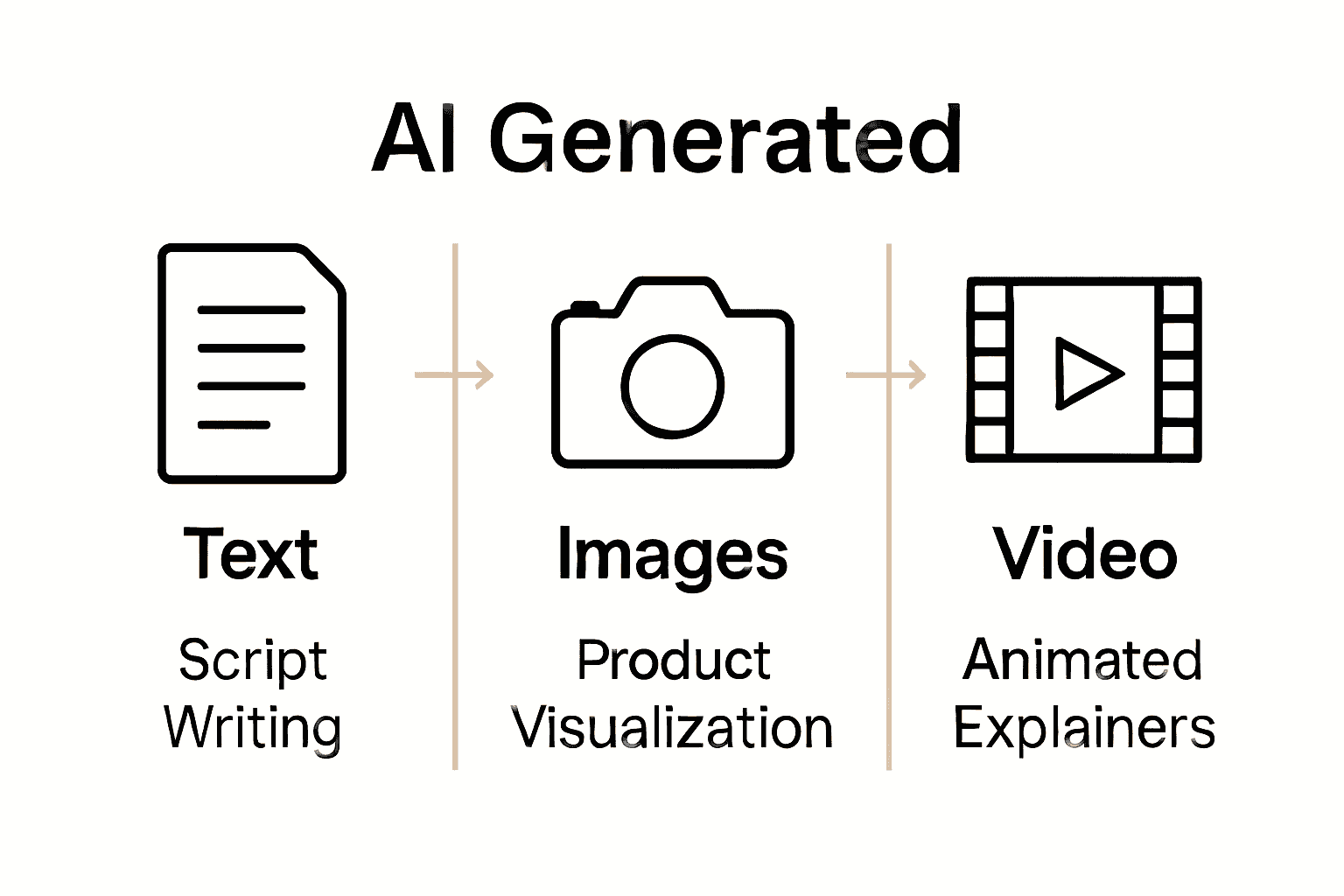
| Content Type | Key Capabilities | Typical Outputs |
|---|---|---|
| Text | Rapid article creation, Contextual writing, Style adaptation | Blogs, Scripts, Ad copy |
| Image | Photorealistic visuals, Concept generation, Style customization | Illustrations, Product visuals, Marketing graphics |
| Video | Automated editing, Scene generation, Character animation | Short clips, Story videos, Training demos |
Key Features of AI Video Creation Platforms
AI video creation platforms represent a sophisticated technological ecosystem designed to simplify and accelerate video production processes. These advanced tools leverage machine learning algorithms to transform creative concepts into professional-grade visual content, offering creators unprecedented capabilities for generating dynamic multimedia experiences.
The core architecture of these platforms typically revolves around intelligent prompt processing systems that translate textual or image-based inputs into comprehensive video narratives. Users can describe scene concepts, character interactions, or emotional tones, and the AI will dynamically generate corresponding visual sequences. This transformative approach eliminates traditional barriers of video production, enabling creators with minimal technical expertise to produce high-quality content rapidly.
Key features that distinguish advanced AI video creation platforms include:
- Intelligent Scene Generation: Automatic creation of contextually relevant visual environments
- Dynamic Character Rendering: AI-powered character design and animation capabilities
- Multi-Format Output: Ability to generate videos for different platforms and aspect ratios
- Customizable Styling: Options to adjust visual aesthetics, color palettes, and design themes
- Smart Editing Tools: Automatic transitions, pacing adjustments, and narrative flow optimization
Beyond technical capabilities, these platforms are revolutionizing content creation by democratizing video production. They provide sophisticated tools that previously required extensive professional training, enabling individual creators, small businesses, and large organizations to produce compelling visual narratives with unprecedented speed and efficiency. The future of video creation lies in these intelligent, user-friendly platforms that bridge human creativity with advanced technological capabilities.
Workflow: From Prompt to Professional Output
AI-powered content creation transforms the traditional creative workflow into a dynamic, iterative process that bridges human imagination with technological precision. According to research from Stanford University, the workflow encompasses multiple interaction patterns ranging from fixed-scope curation to complex interdependent creative tasks, demonstrating the sophisticated collaboration between human creators and artificial intelligence.
The typical workflow begins with prompt engineering, where creators craft detailed, nuanced instructions that communicate their vision. These prompts serve as the foundational blueprint, guiding AI systems to generate initial content drafts. Advanced platforms analyze these inputs across multiple dimensions—interpreting not just literal text, but understanding contextual subtleties, emotional undertones, and stylistic preferences that inform the creative output.
Key stages in the AI content creation workflow include:
- Initial prompt submission
- Algorithmic content generation
- Iterative refinement and editing
- Style and aesthetic customization
- Final output rendering and format optimization
The most sophisticated AI video creation platforms enable iterative collaboration, allowing creators to progressively refine outputs through multiple interaction cycles.
This approach transforms content generation from a linear process into a dynamic conversation between human creativity and machine intelligence. Creators can incrementally adjust visual styles, narrative structures, and technical parameters, enabling unprecedented levels of customization and creative control while dramatically reducing traditional production timelines.
Real-World Applications and Industry Use Cases
Artificial Intelligence has rapidly transformed content creation across diverse industries, offering innovative solutions that extend far beyond traditional creative boundaries. By leveraging advanced machine learning technologies, organizations can now generate sophisticated visual and textual content with unprecedented efficiency and precision.
Marketing and advertising represent perhaps the most immediate beneficiaries of AI-driven content generation. Brands can now produce dynamic social media campaigns, personalized video advertisements, and targeted marketing materials that adapt instantly to specific audience demographics. Small businesses and global corporations alike can create high-quality visual narratives without requiring extensive creative teams or substantial production budgets.
Critical industry applications include:
- Entertainment: Generating animated storyboards, concept art, and preliminary video sequences
- Education: Creating engaging instructional videos and interactive learning materials
- Corporate Training: Developing standardized training documentation and demonstration videos
- E-commerce: Producing product showcase videos and personalized shopping experiences
- Healthcare: Creating patient education materials and medical training simulations
- Real Estate: Generating property walkthrough videos and architectural visualizations
Beyond traditional sectors, emerging industries are discovering unique AI content generation applications. Startups, independent creators, and entrepreneurial professionals can now access sophisticated content production tools that were previously accessible only to well-funded media organizations. This democratization of content creation is fundamentally reshaping how visual narratives are conceived, developed, and distributed across global communication platforms.
Risks, Costs, and Common Mistakes to Avoid
AI content generation introduces complex challenges that creators must carefully navigate to ensure responsible and effective use of emerging technologies. According to research from Cornell University, the landscape of AI-generated content presents significant security, privacy, and ethical considerations that demand proactive management and strategic understanding.
Legal and ethical risks represent the most critical considerations for creators. Potential pitfalls include potential copyright infringement, misrepresentation of generated content, and potential violations of intellectual property rights. Creators must develop robust verification processes to ensure generated content meets legal and ethical standards, maintaining transparency about AI's role in content production.
Common mistakes and risks in AI content creation include:
- Overreliance on AI without human oversight
- Failing to verify factual accuracy of generated content
- Neglecting to customize or refine AI-generated outputs
- Ignoring potential bias in AI-generated materials
- Underestimating the importance of prompt engineering
- Not understanding platform-specific usage rights
Financial considerations are equally important. While AI tools can reduce production costs, creators must carefully evaluate subscription models, compute expenses, and potential hidden costs associated with advanced content generation platforms. Successful implementation requires a strategic approach that balances technological capabilities with budgetary constraints, ensuring that AI becomes a cost-effective enhancement rather than an unpredictable expense.
Bring Your AI Content Ideas to Life Instantly
Struggling to bridge the gap between your vision and final video output? As explained in the article, the shift toward AI-powered content creation opens doors to faster production, cost efficiency, and creative flexibility. But the real challenge lies in finding a reliable platform that turns your concepts or prompts into professional-grade videos—without endless editing, technical hurdles, or high expenses.

Experience the difference with Palmedor.ai, where your text prompts or images are transformed into cinematic videos through advanced AI scene management and script generation. Empower your next project with output customization, smart presets, and AI-driven editing—all in one place. Ready to turn complexity into clarity for your brand films or social content? Start creating now with Palmedor.ai's intuitive platform and discover just how easy and powerful modern video production can be.
Frequently Asked Questions
What is AI in content creation?
AI in content creation refers to the use of artificial intelligence technologies to generate various types of content, including text, images, and videos, enhancing the efficiency and creativity of the production process.
What types of content can AI generate?
AI can generate three main types of content: textual content (like articles and scripts), visual content (such as images and illustrations), and video content (including animations and edited videos).
How does prompt engineering influence AI-generated content?
Prompt engineering is crucial as it involves creating detailed instructions that guide AI systems in generating content. Effective prompts are key to achieving high-quality and relevant outputs aligned with the creator's vision.
What are the risks associated with AI-generated content?
Risks include potential copyright infringement, ethical concerns regarding misrepresentation, lack of verification for factual accuracy, and bias in AI outputs, necessitating careful management and oversight during the creation process.