Brand Marketing Video Production: Transforming Strategy
Brand marketing video production empowers brands with impactful storytelling, AI workflows, and flexible formats. Learn process, types, risks, and cost.
Brand Marketing Video Production: Transforming Strategy

More than 90 percent of American marketers say video is central to their brand’s success. Yet many marketing managers and content creators at mid-sized brands feel daunted by the creative and technical demands of building impactful video campaigns. Exploring how smart video production strategies can bridge this gap reveals practical methods for turning complex ideas into compelling stories that connect, without requiring high budgets or specialized film skills.
Table of Contents
- Defining Brand Marketing Video Production
- Popular Video Types For Brand Marketing
- How AI Streamlines Production Workflows
- Key Features And Customization Options
- Costs, Risks, And Common Mistakes To Avoid
Key Takeaways
| Point | Details |
|---|---|
| Importance of Brand Marketing Videos | Brand marketing videos build emotional connections and communicate brand values, making them more impactful than traditional advertising. |
| Diverse Video Formats | Utilizing various video types like product demos and testimonials can strategically engage target audiences and demonstrate brand value. |
| AI in Production | Implementing AI tools can streamline video production processes, allowing for increased efficiency while maintaining creative quality. |
| Avoiding Common Risks | Clear objectives and thorough planning are essential to prevent common pitfalls like unclear messaging and budget overruns in video production. |
Defining brand marketing video production
Brand marketing video production represents a strategic approach to creating visual narratives that communicate a company's core identity, values, and message through professionally crafted audiovisual content. Unlike traditional advertising, these videos go beyond simple promotion to establish meaningful emotional connections with target audiences. Contemporary brand communication research highlights how these productions serve as powerful tools for transforming abstract brand concepts into tangible, memorable experiences.
At its core, brand marketing video production involves several critical components that distinguish it from generic video content. These include developing a coherent narrative strategy, understanding audience psychology, selecting appropriate visual and auditory elements, and creating a compelling storytelling arc that resonates with viewers. The process typically encompasses comprehensive stages such as conceptualization, scripting, visual design, production, post-production editing, and strategic distribution across relevant marketing channels.
Successful brand marketing videos achieve multiple objectives simultaneously. They not only introduce products or services but also communicate brand personality, build trust, and create lasting emotional impressions. By leveraging cinematic techniques, strategic messaging, and nuanced storytelling, these videos can differentiate brands in crowded marketplaces, helping companies stand out through unique visual identities and narrative approaches that connect authentically with target demographics.
Pro tip: When planning your brand marketing video, always develop a clear narrative that reflects your brand's core values and speaks directly to your target audience's aspirations and challenges.
Popular video types for brand marketing
Brand marketing encompasses a diverse range of video formats designed to engage audiences and communicate brand messages effectively. According to recent industry research on video marketing trends, the most successful video types include product demonstrations, educational content, customer testimonials, explainer videos, and webinars. These formats provide strategic opportunities for brands to showcase their unique value propositions while establishing meaningful connections with target audiences.
Each video type serves a distinct strategic purpose in the brand marketing ecosystem. Product videos highlight features and benefits, allowing potential customers to visualize solutions. Educational videos position brands as thought leaders by sharing valuable insights. Customer testimonials build social proof and trust through authentic narrative experiences. Explainer videos break down complex concepts into digestible visual stories, while webinars enable deeper, more interactive engagement with specialized audience segments.
Here's a comparison of popular brand marketing video types and how they support business goals:
| Video Type | Strategic Purpose | Typical Use Case |
|---|---|---|
| Product Demo | Showcase key features | Launch new products |
| Educational Content | Establish thought leadership | Tutorials or how-to series |
| Customer Testimonial | Build trust and social proof | Share client success stories |
| Explainer Video | Simplify complex concepts | Introduce new services |
| Webinar | Deepen audience engagement | Live expert panels or Q&A events |
Contemporary brand marketing strategies increasingly prioritize short-form, dynamic video content that resonates across digital platforms. This includes live streaming, user-generated content, behind-the-scenes glimpses, and interactive video experiences that foster genuine audience connections. Brands are moving beyond traditional advertising toward creating immersive, storytelling-driven content that reflects their core values and speaks directly to viewer emotions and aspirations.
Pro tip: Diversify your video content strategy by rotating between different video types to maintain audience interest and address multiple stages of the customer journey.
How AI streamlines production workflows
Artificial intelligence is revolutionizing video production workflows by automating complex, time-consuming processes that traditionally required extensive manual intervention. AI technologies enable creators to dramatically reduce production timelines, minimize repetitive tasks, and allocate more resources toward creative strategy and storytelling. By intelligently managing technical aspects of video creation, AI empowers marketing teams to produce high-quality content more efficiently and cost-effectively.
The specific ways AI streamlines production workflows are multifaceted and transformative. Automated processes now handle critical tasks such as scene detection, color grading, sound design, subtitle generation, and metadata optimization. These capabilities dramatically reduce human error and accelerate post-production stages. AI-powered media production tools can analyze raw footage, recommend optimal editing sequences, generate dynamic visual effects, and even assist in scriptwriting by providing contextual suggestions and narrative frameworks.

While AI introduces unprecedented efficiency, it simultaneously raises important considerations about creative authenticity and human artistic expression. The most successful implementations view AI as a collaborative tool that enhances rather than replaces human creativity. Marketing teams can leverage AI to handle technical complexities, allowing creative professionals to focus on high-level storytelling, emotional resonance, and strategic brand messaging. This symbiotic approach ensures that technological innovation complements human intuition and artistic vision.
Pro tip: Integrate AI tools incrementally into your workflow, starting with specific, well-defined tasks to build comfort and understand their potential before full-scale implementation.
Key features and customization options
Brand marketing video production offers sophisticated customization options that empower organizations to craft unique visual narratives reflecting their core identity and strategic objectives. These features go beyond simple video creation, enabling brands to design immersive experiences that resonate deeply with target audiences. By integrating brand-specific visual elements, messaging frameworks, and storytelling techniques, companies can transform standard video content into powerful communication tools that drive engagement and brand recognition.
The comprehensive customization landscape includes multiple critical dimensions. Brands can personalize video content through strategic elements such as color palette selection, logo integration, typography choices, and narrative tone. Video production platforms now offer extensive format adaptability, allowing seamless creation of diverse content types including product demonstrations, testimonial narratives, behind-the-scenes glimpses, and educational explainers. This flexibility enables marketing teams to develop a cohesive yet dynamic visual strategy that can be efficiently repurposed across different digital platforms and communication channels.
Advanced customization capabilities extend beyond visual design to include nuanced technical and strategic options. These might encompass adjustable video lengths, multiple aspect ratios for different social media platforms, language localization features, interactive elements, and adaptive content templates. Such granular control allows brands to create precisely targeted video experiences that speak directly to specific audience segments, cultural contexts, and marketing objectives. The goal is not just aesthetic customization, but creating meaningful, contextually relevant visual communication that drives genuine audience connection.
Pro tip: Develop a comprehensive brand video style guide that outlines precise visual, narrative, and technical parameters to ensure consistent customization across all video production efforts.
Costs, risks, and common mistakes to avoid
Brand marketing video production involves substantial strategic considerations that extend far beyond simple creative execution. Financial investments can quickly escalate without proper planning, making it critical to understand potential pitfalls and develop robust risk mitigation strategies. Successful video marketing requires a delicate balance between creative vision, technical execution, and strategic alignment with broader business objectives, necessitating a comprehensive approach to budgeting and production management.
The most significant risks emerge from fundamental strategic missteps. Common production mistakes often stem from inadequate pre-planning and unclear messaging objectives, which can lead to expensive reworks and diminished campaign effectiveness. Critical errors include attempting to communicate multiple complex messages in a single video, misaligning content tone with target audience expectations, and neglecting platform-specific optimization requirements. These mistakes can result in substantial financial waste, reduced audience engagement, and potential brand credibility erosion.
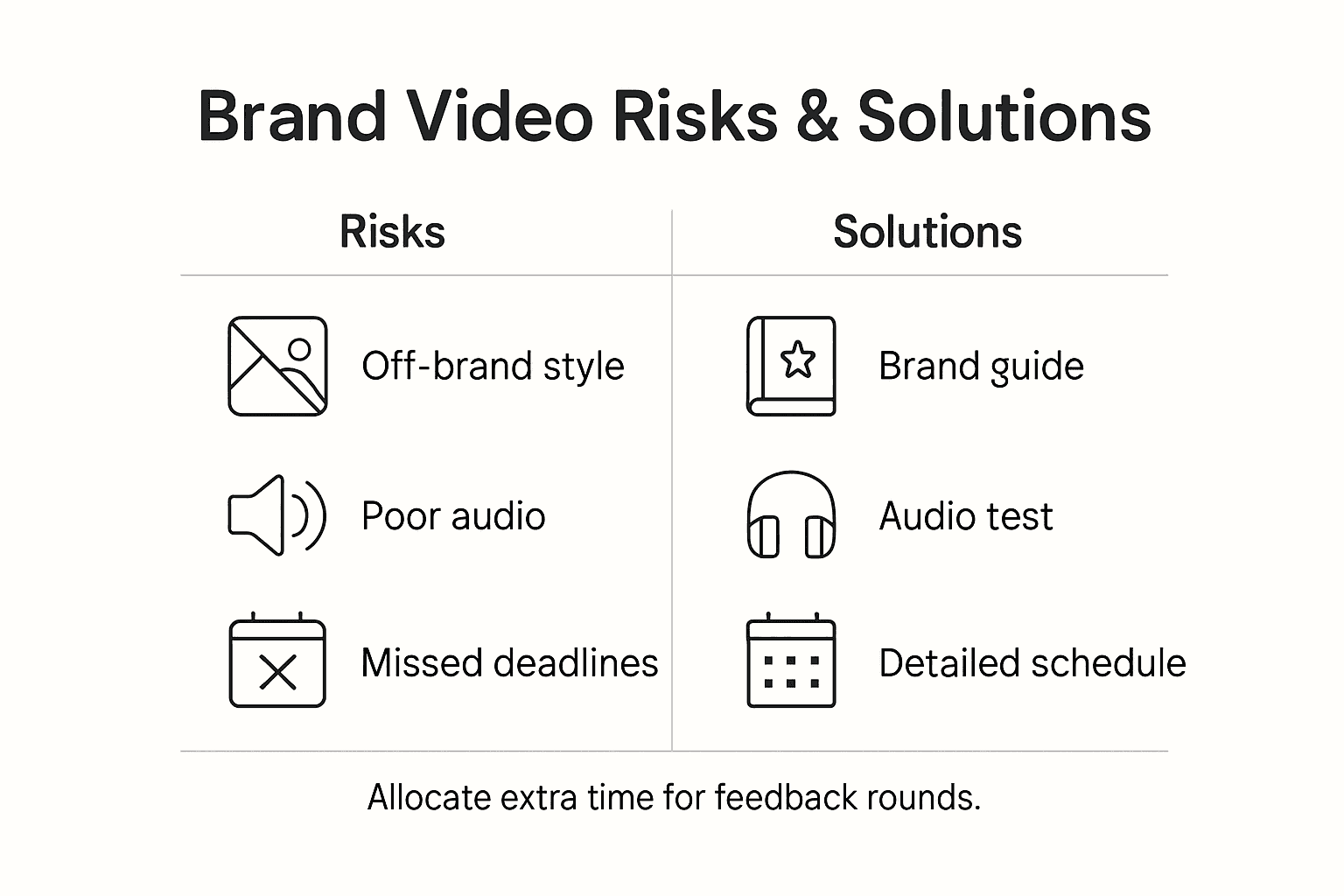
The following table summarizes the main risks in brand marketing video production and how to mitigate them:
| Risk | Potential Impact | Recommended Mitigation |
|---|---|---|
| Unclear messaging | Confused audience, low impact | Define objectives before scripting |
| Inadequate planning | Budget overruns, delays | Create detailed production roadmap |
| Ignoring platform needs | Poor distribution performance | Optimize for each platform's specs |
| Overly complex videos | Diluted messaging, viewer drop | Focus on a single clear narrative |
Effective risk management in brand video production demands a multifaceted approach. Organizations must establish clear creative frameworks, set measurable performance metrics, conduct thorough audience research, and maintain disciplined budget control. This involves creating detailed production guidelines, implementing rigorous quality assessment processes, and developing flexible content strategies that can adapt to evolving market dynamics. Successful brands treat video production as a strategic investment, carefully balancing creative ambition with financial prudence and measurable performance expectations.
Pro tip: Allocate at least 20% of your video production budget as a contingency fund to address unexpected challenges and maintain project flexibility.
Elevate Your Brand Marketing Video Production with AI-Powered Efficiency
Creating compelling brand marketing videos that clearly communicate your core values and resonate emotionally can be challenging. From developing focused narratives to managing complex production workflows and ensuring platform optimization, the process often demands extensive planning and expertise. If you aim to avoid common pitfalls like unclear messaging, planning delays, or overwhelmed budgets, leveraging intelligent automation could transform your approach.
Palmedor.ai offers a cutting-edge AI-powered video creation platform designed precisely to address these challenges. With features like automated script generation, scene management, smart presets, and customizable output formats, you can craft professional-grade videos aligned perfectly with your brand’s story and audience expectations. Whether you want to produce engaging product demos, educational content, or customer testimonials, Palmedor.ai helps you streamline production workflows while preserving creative authenticity.
Discover how to simplify your brand marketing video production today and bring your vision to life with minimal effort.
[Image:cta_image]
Start transforming your brand storytelling now by exploring Palmedor.ai. See how the platform’s smart tools can empower you to create cinematic videos that elevate your strategy and deliver measurable impact. Don’t let complex production slow you down when professional results are just a few clicks away.
Frequently Asked Questions
What is brand marketing video production?
Brand marketing video production is a strategic approach to creating videos that convey a company's identity, values, and messages through engaging audiovisual content, aiming to build emotional connections with audiences rather than just promoting products.
What types of videos are most effective for brand marketing?
Effective video types for brand marketing include product demonstrations, educational content, customer testimonials, explainer videos, and webinars, each serving unique purposes in showcasing brand value and fostering audience engagement.
How can AI improve brand marketing video production?
AI can streamline production workflows by automating tasks such as scene detection, color grading, and subtitle generation, enabling creators to focus on storytelling while reducing production time and costs.
What are common mistakes to avoid in brand marketing video production?
Common mistakes include unclear messaging, inadequate planning, neglecting platform-specific optimization, and overly complex videos. To mitigate these risks, it’s essential to define clear objectives, create detailed production plans, and focus on a single narrative.