7 Essential AI Video Strategies for Modern Video Agencies
Discover 7 actionable AI-powered tips specifically for video agencies to boost efficiency and create high-quality video content for clients worldwide.
7 Essential AI Video Strategies for Modern Video Agencies

Producing video content for clients often means your team is pulled in too many directions at once. Tight deadlines and constant revision requests leave you wishing for more hours in the day. But technology is changing the rules. From script creation to post-production, artificial intelligence now offers real solutions to speed up every stage of your workflow and reduce manual effort.
By learning how AI can work for your agency, you can take on more projects, improve creative quality, and avoid the bottlenecks that slow you down. These practical insights will show you how to automate tedious tasks, enhance creative output, and maintain brand consistency across every video you produce. Get ready for proven strategies that make your team more productive and your agency more competitive.
Table of Contents
- Leveraging AI For Fast Script Generation
- Transforming Creative Ideas Into Video Concepts
- Streamlining Scene Management With Automation
- Customizing Video Output For Multiple Platforms
- Using Smart Presets To Maintain Brand Consistency
- Simplifying Team Collaboration In Video Creation
- Scaling Production Without Technical Expertise
Quick Summary
| Takeaway | Explanation |
|---|---|
| 1. Leverage AI for Script Generation | Use AI to generate scripts quickly, saving time and enhancing quality. |
| 2. Transform Ideas into Video Concepts | Utilize AI to structure vague ideas into actionable video concepts, expediting the production process. |
| 3. Automate Scene Management | Implement AI to organize footage efficiently, reducing post-production time significantly. |
| 4. Customize Output for Multiple Platforms | AI optimizes videos for different platforms, ensuring that content meets specific requirements effortlessly. |
| 5. Simplify Team Collaboration | Centralize feedback and revisions through a collaboration platform to streamline communication and reduce errors. |
1. Leveraging AI for Fast Script Generation
Script generation is where AI truly shines for video agencies. Instead of spending days crafting video scripts from scratch, AI powered by large language models can produce polished, creative scripts in minutes. This isn't about replacing your creative team, it's about giving them a powerful head start that lets them focus on refining ideas rather than staring at blank pages.
The magic happens through intelligent collaboration between you and AI. Research shows that AI-driven systems assist users throughout the entire writing process, from initial ideation and outline creation through drafting and final editing. When you provide AI with clear direction, it handles the heavy lifting of generating coherent, contextually relevant content that matches your brand voice and target audience. Your team can then review, tweak, and perfect what the AI produces, dramatically accelerating your production timeline. For a mid-sized agency managing multiple client projects simultaneously, this workflow reduces the time spent on scriptwriting from days to hours. You overcome writer's block faster, maintain full creative control, and consistently produce higher quality outputs with significantly less manual effort.
Here's where this becomes practical for your agency operations. Start by building a library of proven prompts specific to your content types. When a client requests a 30-second social media clip, you feed your prompt into an AI script generator, get three solid options in 10 minutes, and present them to the client for feedback. If they want adjustments, you refine the prompt and regenerate alternatives rather than starting from zero. The integration of AI in scriptwriting also means your newer team members can produce scripts at the level of seasoned writers, evening out your creative output quality. You're not just working faster, you're working smarter by leveraging technology to amplify what your team can accomplish.
Pro tip: Create a prompt template that includes your client's target audience, brand tone, key message, and desired length, then save it as a reusable formula so each new script request takes just seconds to set up.
2. 2. Transforming Creative Ideas into Video Concepts
Every great video starts as a vague spark in someone's mind. A client calls with enthusiasm but struggles to articulate exactly what they want, or your creative director has a compelling vision that needs structure. This is where AI becomes your translation tool, converting those abstract ideas into concrete, actionable video concepts that your team can actually produce.
The challenge agencies face is bridging the gap between inspiration and execution. When clients describe their ideas verbally or in scattered notes, you still need to translate that into visual sequences, shot lists, character descriptions, and narrative arcs. AI facilitates the translation of abstract ideas into structured video concepts by processing your inputs and generating organized frameworks that guide production. Instead of spending hours in brainstorming sessions creating mood boards and storyboard sketches, AI tools can rapidly generate multiple concept variations based on your direction. You provide the raw creative input, and AI structures it into professional video concepts complete with scene breakdowns, visual descriptions, and pacing suggestions. This accelerates the conceptualization phase from days to hours, allowing your team to move into production faster while maintaining the creative vision that made the original idea compelling.
For your agency workflow, this means presenting clients with polished concept documents weeks earlier. Imagine a client describing a brand film about sustainability and heritage. You feed that description into an AI concept generator along with visual references, target audience demographics, and brand guidelines. Within minutes, you receive structured concepts including scene descriptions, visual tone, character archetypes, and narrative progression. Your creative team then refines these concepts, selects the strongest direction, and develops the full production plan. This approach also democratizes concept development across your team, since less experienced creatives can produce professional quality concepts that rival those from senior staff. You're handling more projects simultaneously without stretching your creative resources thin, and clients see tangible progress toward their vision faster.
Pro tip: Save your most successful client briefs and concept outputs as templates, then use them as reference inputs when new clients have similar project goals to generate concepts that already align with proven winners.
3. 3. Streamlining Scene Management with Automation
Scene management is where most video production timelines collapse. You have dozens of footage clips, multiple takes, various angles, and countless edits that need organization before your team can even start assembling the final product. Manually sorting through hours of raw footage to identify usable scenes, tag them, and organize them for editing is tedious work that consumes days of production time. AI automation transforms this bottleneck into a streamlined process.
Traditionally, your editors spend significant time watching footage, identifying key moments, marking in and out points, and creating organizational systems that the rest of the team can understand. AI technologies automate scene detection and video editing by analyzing footage, automatically identifying key scenes, and suggesting cuts without requiring constant human intervention. The system watches your footage, recognizes scene boundaries, detects the best takes based on visual quality and continuity, and flags moments that match your editing preferences. This doesn't mean the AI does the creative work for you. Instead, it handles the heavy analytical lifting so your editors review organized, flagged footage instead of raw material. The result is production time reduced by weeks, fewer errors in scene selection, and your creative team focusing on storytelling rather than administrative tasks. When you're managing multiple projects simultaneously, this efficiency gain directly impacts your bottom line and your ability to take on additional clients.
For your agency, this means your editors go from spending three days sorting and organizing footage to reviewing AI-suggested scenes in a few hours. Picture a commercial shoot that generated forty gigabytes of footage. An AI system automates complex post-production processes including scene management and video organization. The AI ingests all that footage, identifies the cleanest takes, groups similar shots together, flags continuity issues, and creates a searchable library organized by scene type, talent, location, and performance quality. Your team then jumps directly into the creative assembly phase, choosing between pre-organized options rather than hunting through chaos. This consistency also means different editors working on different projects produce similar quality outputs, since everyone is working from the same organized scene library.
Pro tip: Tag your footage with consistent metadata before uploading to your AI system so it learns your naming conventions and quality standards, then applies those same criteria automatically to future projects.
4. 4. Customizing Video Output for Multiple Platforms
One video rarely works everywhere. What performs brilliantly on Instagram requires completely different formatting for YouTube, TikTok, LinkedIn, and your client's website. Your team traditionally spends hours resizing, re-editing, adjusting captions, and recreating videos for each platform. AI automation eliminates this repetitive work by intelligently customizing video output across multiple distribution channels simultaneously.
Different platforms have fundamentally different requirements that go beyond simple resizing. Instagram Stories demand vertical 9:16 aspect ratios with large text overlays, while YouTube prefers 16:9 landscape with detailed descriptions. TikTok viewers expect faster cuts and trending audio, whereas LinkedIn audiences respond to longer form content with professional messaging. Manually creating separate versions of each video multiplies your production workload, yet ignoring platform optimization means your content underperforms. AI solves this by automating optimization for multiple social media platforms by adjusting aspect ratios, durations, captions, and visual styles to match each channel's specifications. The system analyzes platform specific preferences and engagement patterns, then automatically produces platform optimized versions that maintain your core message while maximizing reach. You create one master video, and AI generates perfectly formatted versions for every platform in your distribution strategy. This approach also ensures consistency in your brand messaging across channels while saving your team from monotonous formatting tasks.
For your agency clients, this multiplies content value dramatically. Imagine producing a 60 second brand film for a retail client. Instead of your team spending two days manually creating versions for Instagram, TikTok, YouTube, LinkedIn, and their website, you feed the master video into an AI optimization system. The AI generates identity preserving videos customized for multiple platforms with appropriate aspect ratios, caption placement, pacing adjustments, and visual emphasis that matches each platform's audience behavior. Within an hour, your client has eight perfectly optimized versions ready for distribution. Each version maintains the brand identity and core message while presenting content in the format that performs best on that specific platform. This means you can offer clients multi platform distribution as a standard service rather than a costly add on, improving your agency's margins while delivering better results for their campaigns.
Pro tip: Build a master template library that documents optimal specs, caption styles, and pacing preferences for each platform you regularly use, then reference these when setting up your AI customization parameters for consistent results.
5. 5. Using Smart Presets to Maintain Brand Consistency
Brand consistency across video content is harder than it looks. One video has warm, golden tones. Another feels cool and sterile. A third looks washed out. When your agency produces multiple videos for the same client across different shoots, seasons, and conditions, maintaining a cohesive visual identity requires either a color grading expert reviewing every frame or tedious manual adjustments. Smart presets powered by AI eliminate this inconsistency problem by automating the process of applying consistent visual treatment across all your content.
Every brand has a specific visual identity built into their color palette, saturation levels, contrast preferences, and overall aesthetic mood. When your team manually color grades each video, you're asking editors to remember and replicate these standards perfectly every single time, which introduces variability and consumes hours of labor. AI-powered smart color grading presets help creators achieve consistent visual branding by automating the color correction process to align with the brand's established color palette and aesthetic standards. You create a preset based on the client's brand guidelines, then apply it across every video in a project. The AI learns what makes that brand's visual signature distinctive and applies those same color relationships, saturation levels, and tonal characteristics to new footage automatically. This ensures every video maintains the brand identity while reducing post-production time significantly. Your newer team members produce color graded work that matches the quality of your most experienced colorists, eliminating skill variance from your output.
Implementing this strategy transforms your client relationships. When you onboard a new client, you spend an hour developing a custom smart preset that captures their brand's visual DNA. Every subsequent video they commission gets that preset applied automatically, ensuring consistency they can rely on. A fashion brand shooting seasonal campaigns gets the same warm, luxurious color treatment across all their videos regardless of shooting location or weather conditions. A tech company maintains their cool, modern aesthetic across corporate videos, product demos, and testimonials. You reduce post-production time per video, improve consistency, and can offer this as a premium service that justifies higher production rates. The preset also serves as documentation of the client's visual standards, making it easy to onboard new team members or work with freelancers who understand exactly what the client expects.
Pro tip: Create your smart presets using a diverse range of footage from the client's previous work so the AI learns from their existing visual library and maintains continuity with content they already approve of.
6. 6. Simplifying Team Collaboration in Video Creation
Video production involves countless moving parts and multiple stakeholders. Your editors need feedback from creative directors. Clients want to review cuts before major decisions. Sound designers need to coordinate with video editors. Without a centralized system, feedback gets lost in email threads, revision requests contradict each other, and timeline delays multiply. A unified collaboration platform transforms this chaos into an organized workflow where every team member and stakeholder works from the same information.
Traditional collaboration in video production creates bottlenecks at every stage. Someone uploads a rough cut to a file sharing service, then waits for feedback via email or messaging apps. Comments arrive scattered across different platforms, some addressing the same issue without realizing it. Revisions happen, but it's unclear which version incorporates which feedback. Timeline expectations blur. Centralizing feedback and enabling real-time editing significantly reduces revision cycles and accelerates delivery time. Modern collaboration tools allow stakeholders to view video content, make timestamped comments directly on specific frames, and track which revisions address which feedback. Your creative director can flag a specific transition at the 12-second mark. Your client can request color adjustments on a particular shot without confusion. Your editors see all these comments organized in one place and understand exactly what needs changing. Everyone views the same version, preventing the confusion caused by multiple file iterations floating around.
For your agency, this transforms how you manage projects and client relationships. Imagine a thirty-second commercial in production. Your internal team uploads the first cut to your collaboration platform. The creative director reviews it and leaves timestamped feedback on three specific moments. The client receives a notification, reviews the same video with the same interface, and adds their comments. Your editor sees all feedback organized chronologically by timecode. Rather than spending an hour deciphering scattered feedback, your editor spends twenty minutes implementing clear, specific revisions. The second version goes back to review, and the feedback cycle repeats faster because everyone uses the same system. This structured approach reduces revision rounds, accelerates client approvals, and means you can take on more concurrent projects without proportionally increasing your management overhead. You also create a documented revision history that protects you against scope creep and last-minute requests, since everything is timestamped and trackable.
Pro tip: Train your clients on the collaboration platform during onboarding so they understand how to leave effective feedback by timecode, which dramatically reduces confusing revision requests and speeds up approval cycles.
7. 7. Scaling Production Without Technical Expertise
Most video agencies face the same growth challenge. Client demand increases, but hiring specialized talent is expensive and time consuming. You need more video production capacity, but finding skilled editors, motion graphics artists, and technical operators stretches budgets and timelines. AI powered platforms eliminate this bottleneck by enabling team members without deep technical expertise to produce professional quality videos independently. This means your existing staff can handle significantly more projects, and you can scale production without the traditional technical skill requirements.
Traditionally, video production requires specialized expertise at every stage. You need editors who understand color theory and pacing. Motion graphics designers require proficiency with complex software. Sound designers need technical audio knowledge. This specialization creates bottlenecks because each role requires trained professionals, and finding enough qualified people limits your growth ceiling. AI platforms abstract away much of this technical complexity by providing intuitive interfaces and intelligent automation. A junior team member can input creative direction and let the platform handle technical execution. Someone without color grading experience can apply professional color treatments automatically. A non-technical producer can assemble complex edits by describing what they want rather than manually constructing timelines. The platform handles the technical heavy lifting while your team focuses on creative decisions and strategic direction. This democratization of video production means your team's output capacity multiplies without proportionally increasing your headcount or wage expenses.
For your agency's growth strategy, this changes everything about how you scale. You can take on significantly more client projects by distributing work across your existing team in ways that weren't possible before. A junior coordinator can handle repetitive editing tasks that would previously require an experienced editor. Your creative directors focus on strategic decisions rather than technical execution. New hires ramp up faster because they don't need months of technical training before contributing meaningfully to projects. You can also offer more aggressive timelines to clients since your production capacity isn't limited by the number of specialists you employ. This translates to higher margins per project and the ability to pursue larger clients with demanding schedules. You're essentially multiplying your team's productive output by removing technical barriers that previously locked tasks behind specialist expertise. This approach also improves team satisfaction because people spend time on creative work rather than repetitive technical tasks, making it easier to retain talent and attract new people to your agency.
Pro tip: Identify your most repetitive, technical heavy tasks and experiment with delegating them to less experienced team members using AI tools first, then measure both quality and time savings to understand where you gain the most production leverage.
This table summarizes the main strategies and advancements described in the article regarding leveraging AI in video production workflows.
| Topic | Description | Benefits |
|---|---|---|
| AI for Script Generation | Utilize AI to rapidly generate initial drafts of video scripts, providing a strong starting point for creative teams. | Reduces scriptwriting time, maintains creative focus, and overcomes writer's block. |
| Transforming Ideas into Concepts | AI aids in structuring vague creative concepts into actionable video production plans with organized frameworks. | Accelerates conceptualization phases, bridges gaps between inspiration and execution, and democratizes idea development. |
| Automated Scene Management | Automatically detects, tags, and organizes video footage for editors using AI. | Reduces time spent on organizing footage, allows quicker transition to creative editing, and minimizes errors. |
| Customizing for Multi-Platform Output | AI adjusts video specifications to match different platform demands, such as aspect ratios, pacing, and captions. | Ensures optimized performance across channels, saves time, and upholds brand coherence. |
| Smart Presets for Brand Consistency | Apply AI-powered smart presets to maintain visual branding across diverse video content. | Achieves consistent aesthetics, reduces post-production effort, and ensures brand identity in outputs. |
| Enhancing Team Collaboration | Implement centralized collaboration platforms to streamline feedback and revisions in video projects. | Simplifies communication, reduces revision cycles, and enhances project management. |
| Scaling Production with AI Assistance | Expand production capacity by using AI tools to enable non-specialist team members to complete technically demanding tasks. | Increases project throughput, lowers dependency on specialized staff, and enhances team satisfaction. |
Unlock Your Agency's Full Potential With AI Video Solutions
The article highlights critical challenges faced by video agencies such as lengthy scriptwriting, chaotic scene management, and the struggle to maintain brand consistency across multiple platforms. If you are looking to overcome writer's block, accelerate concept development, or streamline your production workflow without compromising quality, you need an intelligent solution that adapts to your creative process. Palmedor.ai empowers your team to generate polished scripts, automate scene organization, and apply smart presets that keep your brand visuals cohesive—all while scaling production without requiring deep technical expertise.
With features designed specifically for modern video agencies, Palmedor.ai transforms your creative ideas into professional-grade videos swiftly and effortlessly. Whether you want to produce social clips or cinematic brand films, our AI platform supports every stage of your workflow—from script generation to multi-platform output customization. See these benefits in action and experience how easy it is to boost your productivity and client satisfaction today.
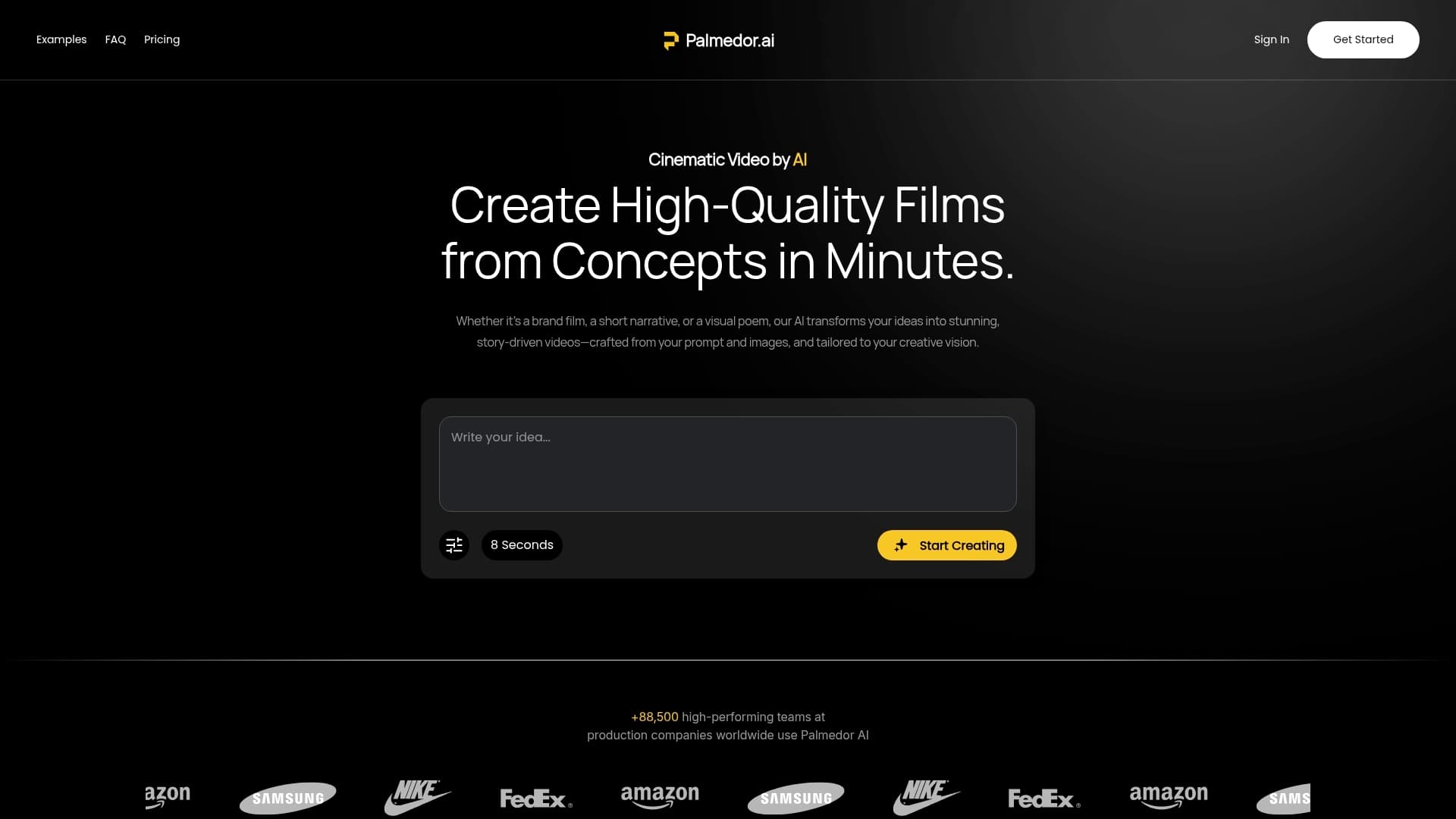
Ready to accelerate your video production while maintaining full creative control Use Palmedor.ai to revolutionize your workflow now Visit Palmedor.ai to start creating cinematic videos from simple prompts and images instantly Discover how our AI-powered video platform helps you produce brand-consistent, platform-optimized videos faster and smarter than ever before
Frequently Asked Questions
How can I leverage AI for fast script generation in my video agency?
Using AI for script generation allows your team to produce polished scripts in minutes instead of days. Start by crafting specific prompts that reflect your brand voice and desired content; this can dramatically reduce your scriptwriting time by up to 80%.
What are effective ways to transform creative ideas into video concepts with AI?
AI can convert vague ideas into structured video concepts by processing your inputs and generating organized frameworks. To get started, feed AI specific creative directions and existing visual references; this can help your team finalize concepts within hours instead of days.
How can I streamline scene management with AI automation in video production?
AI can automate the process of sorting and organizing footage, significantly reducing the time your editors spend on these tasks. Implement this by tagging your footage with consistent metadata before uploading it; this can cut down scene management from days to just a few hours.
How does AI assist in customizing video output for different platforms?
AI can automatically adjust videos to meet the requirements of various social media platforms, saving considerable time and effort in reformatting. Utilize AI to generate multiple versions of a master video tailored for different platforms, ensuring your content is optimized within an hour.
What strategies can I use to maintain brand consistency across multiple videos?
You can create smart presets powered by AI that automate color grading according to your client's brand guidelines. Spend time developing a preset based on their visual standards, and apply it to every video project; this can enhance consistency and reduce post-production time by around 50%.
How can I simplify team collaboration during video creation?
Implement a centralized collaboration platform that allows real-time editing and timestamped feedback to streamline communication among team members. Train your clients to use this platform effectively during onboarding; this can significantly reduce revision cycles and improve project timelines.