AI Video Creation Explained: Transforming Ideas Effortlessly
AI video creation lets filmmakers and creators turn prompts into cinematic videos. Discover platform types, workflow, risks, cost, and real-world use cases.
AI Video Creation Explained: Transforming Ideas Effortlessly

Every filmmaker knows the challenge of turning bold ideas into visually striking stories without technical hassle. The rise of AI video generation gives creators across the globe powerful tools for producing high-quality content with minimal complexity. By leveraging advanced methods like text-to-video and customizable avatars, platforms are making professional-level video creation accessible to nearly anyone. This article highlights the core concepts and practical solutions for using AI-powered video generation technologies that transform creative vision into compelling marketing and storytelling assets.
Table of Contents
- Core Concepts of AI Video Creation
- Popular Platforms and Generation Methods
- Workflow Features and Customization Options
- Common Pitfalls and Cost Structures
- Legal, Ethical, and Creative Implications
Key Takeaways
| Point | Details |
|---|---|
| AI Video Generation Technology | AI video creation utilizes advanced machine learning to transform concepts into dynamic visual narratives, thereby revolutionizing content production. |
| Generation Methods | Various methods such as text-to-video and image-to-video allow creators to generate specific content suited to their needs, enhancing creativity and efficiency. |
| Customization Options | AI platforms offer granular control over visual styles and narratives, enabling creators to fine-tune their projects and maintain brand consistency. |
| Legal and Ethical Considerations | It is crucial for creators to understand copyright and ethical implications, ensuring they utilize AI responsibly and maintain transparency in their work. |
Core Concepts of AI Video Creation
AI video creation represents a groundbreaking technological frontier where artificial intelligence transforms raw creative concepts into dynamic visual narratives. Sophisticated video generation technologies are revolutionizing how creators produce content across multiple domains.
At its core, AI video generation involves complex computational processes that synthesize visual sequences using advanced machine learning techniques. The fundamental mechanisms rely on several critical components:
- Generative Models: Neural networks trained to understand and recreate visual patterns
- Input Processing: Converting text, images, or audio signals into video representations
- Sequence Synthesis: Generating coherent motion and temporal transitions
- Quality Enhancement: Refining visual details and realistic movements
AI-powered video generation frameworks leverage multiple technological approaches, including generative adversarial networks (GANs), variational autoencoders (VAEs), and advanced diffusion models. These technologies enable sophisticated transformations from conceptual inputs to polished video content.
The technical complexity behind AI video creation involves intricate computational strategies. Machine learning algorithms analyze vast datasets, learning complex visual grammar and motion patterns that allow for intelligent content generation. By understanding contextual relationships between visual elements, these systems can create remarkably nuanced and contextually appropriate video sequences.
Pro tip: Start with clear, detailed prompts when generating AI videos to help the system understand your creative vision more accurately.
Popular Platforms and Generation Methods
AI video generation platforms have rapidly evolved, offering creators sophisticated tools to transform imaginative concepts into dynamic visual content. Advanced video generation technologies now provide unprecedented flexibility across multiple creative domains.
The current landscape of AI video generation encompasses several core technological approaches:
- Text-to-Video Generation: Converting written descriptions into visual narratives
- Image-to-Video Transformation: Animating static images with intelligent motion
- Avatar Synthesis: Creating personalized digital characters with realistic movements
- Motion-Based Generation: Generating sequences based on predefined movement patterns
These AI-powered generation frameworks leverage cutting-edge machine learning models like generative adversarial networks (GANs), diffusion models, and neural radiance fields. Each approach offers unique capabilities for transforming raw inputs into sophisticated video content.
Here's a comparison of major AI video generation methods and their best use cases:
| Generation Method | Typical Input | Ideal Use Case | Key Strength |
|---|---|---|---|
| Text-to-Video | Written description | Marketing ads, storytelling | Quick concept creation |
| Image-to-Video | Static imagery | Character animation, demos | Realistic movement |
| Avatar Synthesis | User profile, photo | Personalized video messages | Individual customization |
| Motion-Based Generation | Motion data, script | Sports highlights, tutorials | Accurate action replay |
Modern platforms distinguish themselves through specialized features tailored to different creative needs. Some focus on marketing content, while others specialize in educational videos, entertainment, or personalized storytelling. The technological sophistication allows creators to generate high-quality videos with minimal technical expertise, democratizing visual content production.
Pro tip: Experiment with multiple generation methods and platforms to discover the approach that best matches your specific creative vision and technical requirements.
Workflow Features and Customization Options
AI video production workflows represent a sophisticated blend of creative vision and technological precision. Advanced workflow strategies empower creators to transform abstract concepts into compelling visual narratives with unprecedented flexibility.
The typical AI video creation workflow encompasses several critical stages:
- Idea Generation: Conceptualizing the core narrative and messaging
- Script Development: Crafting precise textual guidelines for the AI
- Prompt Engineering: Designing nuanced input instructions
- Visual Asset Creation: Generating initial imagery and scene components
- Refinement and Iteration: Systematically improving video quality
Comprehensive AI video production processes offer extensive customization options that enable creators to fine-tune every aspect of their content. These customization features typically include:
- Selecting AI avatars with specific characteristics
- Adjusting visual styles and aesthetic preferences
- Configuring narrative pacing and emotional tone
- Implementing multilingual voiceover options
- Adding contextual subtitles and translations
The true power of modern AI video platforms lies in their ability to provide granular control while simplifying complex production processes. Creators can now experiment with multiple visual approaches, rapidly prototype concepts, and produce professional-quality content without extensive technical expertise.
Pro tip: Develop a consistent prompt template that captures your brand's unique style to streamline your AI video generation workflow and maintain visual coherence across projects.
Common Pitfalls and Cost Structures
AI video generation presents creators with exciting opportunities alongside complex financial considerations. Hidden cost challenges can dramatically impact project budgets and overall production strategies.
The most significant cost-related pitfalls in AI video generation include:
- Credit-Based Pricing: Pay-per-generation models that charge for every output
- Quality Variability: Potential for multiple unusable video iterations
- Technical Limitations: Unexpected rendering or processing expenses
- Subscription Complexity: Tiered pricing with unclear feature boundaries
- Computational Resource Costs: High-performance hardware requirements
Understanding the nuanced pricing structures requires careful analysis of platform offerings. Most AI video generation services employ flexible models that balance user accessibility with technological investment:
- Freemium tiers with limited generation capabilities
- Pay-as-you-go credit packages
- Monthly subscription plans with preset generation limits
- Enterprise solutions with custom pricing
Successful creators approach AI video generation as a strategic investment, meticulously tracking generation costs, output quality, and return on creative effort. Sophisticated users develop robust workflows that maximize value while minimizing unnecessary expenditures.
Use this summary to evaluate common AI video generation cost models at a glance:
| Pricing Model | Budget Flexibility | Typical User | Cost Predictability |
|---|---|---|---|
| Freemium | High for newcomers | Hobbyists, beginners | Low, upsell risks exist |
| Pay-per-Credit | Moderate per project | Occasional creators | High for one-off projects |
| Subscription Plan | Stable for frequent use | Commercial teams | Predictable, recurring fee |
| Enterprise Custom | Tailored agreements | Large organizations | Negotiated, project-based |
Pro tip: Establish a strict budget and track your AI video generation costs per project, allocating credits strategically to minimize waste and maximize creative output.
Legal, Ethical, and Creative Implications
The emergence of AI video generation technologies presents a complex landscape of legal, ethical, and creative challenges that demand careful navigation. Ethical implications of generative AI reveal profound questions about creativity, ownership, and human artistic expression.
Key ethical considerations in AI video creation include:
- Copyright Concerns: Potential unauthorized use of training data
- Artist Protection: Risks of displacing human creative professionals
- Misinformation Potential: Challenges in distinguishing authentic content
- Cultural Representation: Ensuring responsible and sensitive AI-generated narratives
- Transparency Requirements: Disclosing AI-generated content origins
Legal frameworks for AI creativity emphasize the critical importance of human authorship and intentional collaboration. The most responsible approach views AI as a sophisticated creative tool that augments rather than replaces human imagination, maintaining the irreplaceable depth of human storytelling and cultural understanding.
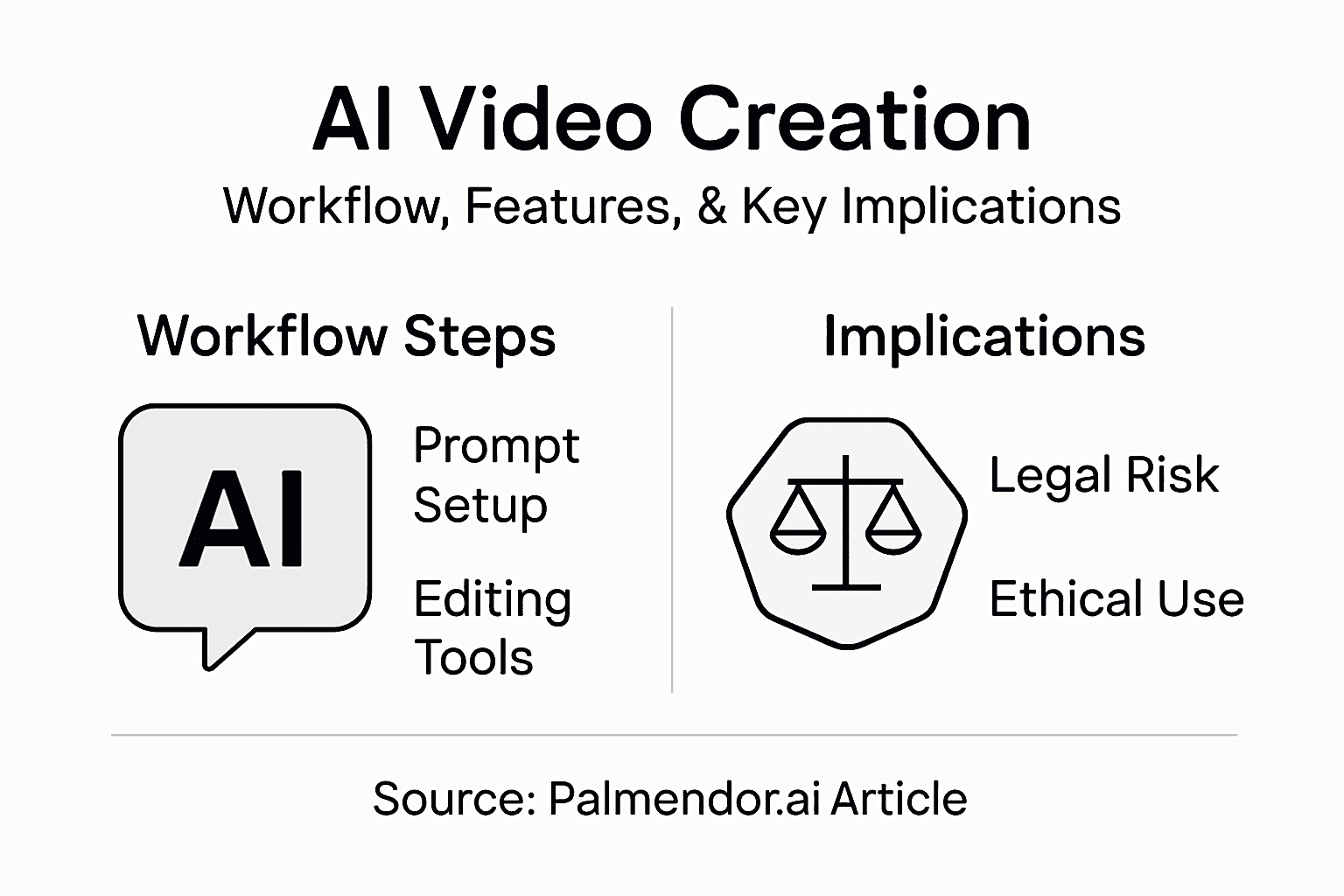
Creative professionals must develop nuanced strategies that leverage AI's capabilities while preserving artistic integrity. This involves establishing clear ethical guidelines, understanding technological limitations, and maintaining a collaborative approach that prioritizes human creativity and vision.
Pro tip: Always disclose AI involvement in your creative process and treat generative technologies as collaborative tools that enhance, rather than replace, human artistic expression.
Unlock Your Creative Vision with Effortless AI Video Creation
The article highlights the complexity and cost challenges creators face when producing AI-generated videos along with the need for clear prompt engineering and workflow customization. If you are looking for a way to transform your ideas into cinematic-quality videos with minimal technical effort Palmedor.ai offers the perfect solution. With features like script generation, scene management, and smart presets you can focus on your creative vision while our AI handles detailed video creation and editing.
Experience flexible pricing plans designed to fit projects ranging from quick social clips to feature-length narratives. Palmedor.ai empowers you to avoid unpredictability in costs and quality by providing a streamlined, professional-grade workflow that matches the advanced techniques discussed in the article. Explore how Palmedor.ai simplifies AI video workflows and discover how to bring your concepts to life flawlessly.
Get started now and see why creators trust Palmedor.ai for high-quality AI video production.
Make your next project effortless and impactful Create your video today

Frequently Asked Questions
What is AI video creation?
AI video creation involves using artificial intelligence to transform creative concepts into dynamic visual narratives through complex computational processes.
How does text-to-video generation work?
Text-to-video generation converts written descriptions into visual narratives, leveraging machine learning models to create coherent video sequences based on text input.
What are common use cases for AI video generation?
Common use cases include marketing ads, character animation, personalized video messages, and educational content, each utilizing different generation methods tailored to specific needs.
What are the main pricing models for AI video generation platforms?
Pricing models typically include freemium tiers, pay-per-credit systems, subscription plans, and custom enterprise solutions, each offering varying degrees of budget flexibility and cost predictability.